Monday, April 27, 2009

Humbert/Angstrom

When John Updike died, I read him for the first time. The New Yorker ran a selection of prose that snared me, particularly a piece about a man joining a pick-up basketball game.

Boys are playing basketball around a telephone pole with a backboard bolted to it. Legs, shouts. The scrape and snap of Keds on loose alley pebbles seems to catapult their voices high into the moist March air blue above the wires. Rabbit Angstrom, coming up the alley in a business suit, stops and watches, though he's twenty-six and six three. So tall, he seems an unlikely rabbit, but the breadth of white face, the pallor of his blue irises, and a nervous flutter under his brief nose as he stabs a cigarette into his mouth partially explain the nickname, which was given to him when he too was a boy. He stands there thinking, the kids keep coming, they keep crowding you up.
I later learned this gorgeous passage was from the beginning of Rabbit, Run. Hard times have reduced the book budget, but I convinced mrs. august to support purchase of the paperback.

I should have gone to the library. Somehow I missed that Updike's quartet of novels feature a first degree schmuck, Harry Angstrom, the "rabbit" of the title who is too timid to make a decision and simply drifts around hoping for a redemptive moment, or at least the passing exhilaration of a good golf swing.

I do not require protagonists to be good. I love Humbert Humbert, who is klutzily evil and is all too gloriously aware of both his demons and his incompetence. In Rabbit, Run, the figure who bothers me is not Rabbit, but Updike.

My sympathy for Humbert comes in spite of my revulsion, but Updike wants to make the revolting sympathetic. Pauline Kael once wrote a review of Clockwork Orange in which she took Stanley Kubrick to task for making the audience cheer on the main character:
Stanley Kubrick's Alex (Malcolm McDowell) is not so much an expression of how this society has lost its soul as he is a force pitted against the society, and by making the victims of the thugs more repulsive and contemptible than the thugs Kubrick has learned to love the punk sadist. The end is no longer the ironic triumph of a mechanized punk but a real triumph. Alex is the only likable person we see -- his cynical bravado suggests a broad-nosed, working-class Olivier -- more alive than anybody else in the movie...
So too with Rabbit Angstrom. He is the only complete character in the novel, and I am meant to see his quest as noble. I'm supposed to feel his pain, to want to leave an alcoholic wife and fart about town in search of sex acts amenable to purple prose. We only meet his abandoned wife for a few pages, the only time the omniscient, present-tense narration enters her mind, just in time for her to drown her baby. Do not commit adultery, but if you do, take the kids

I can see the argument that Humbert is just as bad, that you can't love Lolita without loving Lolita. But in fact you can, and part of what makes Humbert so morosely depressing is the gulf between his reveries and the truth of teenagers. Humbert also anticipated the oversexualized world of now. We should all be so self-hating.

Both Humbert and Angstrom are literary creations that germinated language and allowed new angles on post-war America. The problem is that I don't find Updike's lens to be all that interesting. Maybe it was more revolutionary in 1960 to note that young men can be dissatisfied in their marriages, unable to express their feelings, and self-absorbed. Rabbit is too bland to be incisive, and Updike offers no other opening into the novel's world. I feel no better equipped to make sense of Rabbit and his habitat at the end of the novel, and by then I don't care.

Tuesday, April 14, 2009

Somalia and the Leaden Age of Piracy

Wikifray seems lonely lately. So I decided that I'd share one of my recent posts with it. I rather like this one. It came together fairly quickly, and I think that it's coherent and rational. If you'd like, please comment, either here, or on Nobody In Particular. Thanks, y'all! -Aaron
While Somali pirates have been a quietly brewing story on the back burner for years, their recent seizure of an American ship and crew suddenly lifted the SEP (Somebody Else's Problem) field that had grown up around the issue here in the United States. With their usual outrage of the fact that some lowly foreigners would dare to attack anything American, angry commentators have been filling online comment pages with calls for ground invasions and carpet bombings.

Of course, the situation is much more complicated that many people understand. Gently woven throughout the current news is the idea that Somali piracy is an outgrowth of waterborne vigilantism, sparked by illegal fishing and dumping of toxic waste in the waters off Somalia after the collapse of government there. A quick Google search turned up the fact that Somalia's government was outed by warlords in 1991, and an article in the New Scientist about concerns over the dumping of waste in 1992. NS is a subscription site, so I couldn't read the whole piece, but it seems that foreign companies were looking to make deals with warlords for permission to dump, and they weren't wasting any time.

By the start of 2005, the issue had poked its head into the news again, as the Indian Ocean Tsunami had deposited previously dumped waste on the Somali coastline, and some estimates put the haul from illegal fishing in Somali waters at $300,000,000.00 a year. The infant pirate operations made it into the American news with an attack on the Seabourn Spirit cruise liner, but since the crew drove the pirates off with water cannon and an acoustic device on the ship, American interest quickly faded again.

In Why Terrorism Does Not Work, Max Abrahms makes the point that people see the outcome of an attack as the purpose of an attack. This puts the Somalis in a bit of a bind. People reject the argument that the piracy is a response to the illegal fishing and waste dumping, seeing it (rightly or wrongly) as a self-serving rationalization for common brigandage. But the only attention that their claims of maritime injustice get at all nowadays is within the context of that piracy.

This is not to say that the international community SHOULD consider the root cause of the piracy to be the accusations of foreign fishing and dumping. To do so would remove the Somalis themselves as an active agent in their own activities. And even if these things had not occurred, piracy for ransom takes place in other parts of the world - the former pirate hot spot, the Strait of Malacca, has been largely forgotten recently, but it's not inactive - and it's not a stretch to imagine that a warlord could have hit upon the idea of piracy as a moneymaking venture, or simply to steal goods being shipped. And also ignores another important fact - the best way for Somalia to manage its coastline and fisheries is to have a functioning government that can do the job. Of course, that's going to come with issues of its own. The warlords are unlikely to take kindly to being shut out of power, while the international community is unlikely to accept any government that includes them, and foreign powers have shown a willingness to back efforts to destabilize governments they don't like.

But in the end, the piracy will persist, until it's no longer the most profitable (and not simply in terms of money) option. Simply setting out to make piracy unprofitable can be done - the French have shown a hard-nosed unwillingness to take any flack from the Somalis. If everyone acted in this way, it would likely nip the problem quickly - although some hostages would be killed in the bargain, and public opposition to that in some places will make a unified front unlikely. Or an effort could be made to stabilize the place long enough for a viable government to establish itself, and get the waters around Somalia under control, and keep out illegal fishing and dumping. I'm nor betting on that one, either. Yet. But the status quo won't work forever, and nothing is more constant than change. So we'll see what evolves out of this.

Wednesday, January 14, 2009

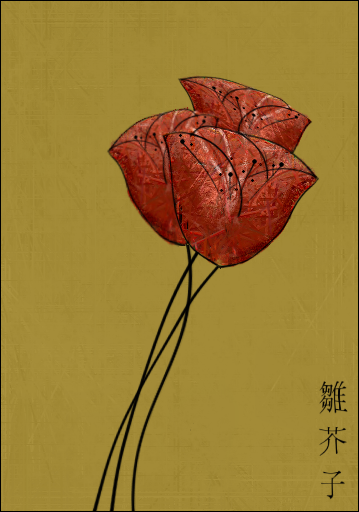
Red Poppy

雛芥子

Saturday, December 20, 2008

The Eighth Day of Christmas

got thumbs?

[click image to view more days of christmas]

Monday, December 01, 2008

Patrick's Diamond

We found the diamond on a Saturday. We were walking with our heads down against the sleet, and there it was, right in front of us. Laying on the sidewalk next to a pile of snow the plows had pushed up over the curb.

It only took us a second to realize what it was, when Patrick snatched it up before another car could drive by, and throw black slush on it. “A diamond! It’s a diamond.” Mom had a diamond ring once, but this one was much bigger. Being the oldest, I was naturally the authority in found treasures. I told Patrick we should take the diamond to a jewelry store, and sell it.

“You mean for money?” The Possibilities: new coats; warm boots; Candy. A Car.

We both hated walking in Omaha. Patrick, especially. I’d grown out of last year’s boots, and he hadn’t yet grown into them.
~
When we first came to Omaha, it was September. Mom and Dad had just split up, and she’d found us a place there to live and a job, too. Dad drove all us kids and our clothes there. And he let us take most of the furniture.

At first, I didn’t wanna move there, but when I saw South 14th street, I knew things might be okay. There was something almost holy about the way our new street looked that afternoon. Almost all the houses were made of warm, red brick. It’s not like I’d never seen brick houses before. Lots of our houses at Lincoln Air Base were made of brick. But I had never seen this many houses packed in a row. And there was brick everywhere. The streets, even the sidewalks were paved with bricks.

And then, every single house had a tree in front of it. All lined up straight, one after the other like they were at a dance. The trees were very old. Some of them reached right across the street, and touched the trees on the other side. The leaves were red, orange, and pink. And the sun touched down on us underneath, only after it had fallen through all those leaves. Red was my favorite colour so I decided this was a sign that life wasn’t gonna be so bad there, after all.

But now it was December, and everything around us was hard and grey. Winter had turned the brick houses mean and bloody, and the bumpy brick street and sidewalks were smothered with a grey slime that people in Omaha called ‘snow.’ Downtown, concrete sidewalks followed us everywhere. They bridged bleak stone buildings to ugly dark streets. And they slapped at the bottoms of our feet every time we took a step. We didn’t have a car, and the bus cost too much so we had to walk everywhere. Sometimes, Patrick’s feet would get so cold, he could barely feel them. Then when we’d finally get inside someplace, they’d start to hurt him so horribly, and he’d start to sniff. But he wouldn’t cry ‘cause then Mom would cry, and Patrick couldn’t stand to see that.
~
But this was a Saturday, and Mom didn’t have to work. We didn’t have to go to school, so we’d headed towards YMCA to play. Standing there with that diamond, we were only two blocks from the jeweler’s. We knew this exactly because we passed it every weekday on the way to the sitter’s.

It took less than a minute to get to the store. It was all lit up on the outside with green and red Christmas lights. The door was wide and covered with a sheet of pink copper, polished shiny, with 4 small framed windows near the top. Beside the door, in a large bay window, there were diamonds and gold watches perched with shiny rings and necklaces of green and red sparkle.

I pushed open the heavy door for Patrick, and he went in first, holding our diamond in his mittened hands, cupping it the way he would a butterfly or a lightening-bug. The floor inside was carpeted in a deep moss green and the room was filled with china dishes. There were goblets and vases of cut glass with little rainbows shining in them. It seemed like there was light everywhere and we could hear the Nutcracker Suite. We started to feel toasty warm right away.

There were two round men bent over a glass cabinet whispering. Behind them was a grandfather clock like the one on Captain Kangaroo, but more elegant.

“What do we do?” Patrick whispered to me.

“I don’t know.” And I didn’t, now that we were here. I’d been with my mother the week before, when she’d sold her wedding rings but that place had been filled with guns, old push-mowers, and picture frames hanging from the ceilings tangled with gas lanterns and fishing poles. Nobody there whispered, except Mom.

The man who’d bought her rings that day wore a green plaid shirt, and he had dirty fingernails. And when he smiled, I saw dark stuff on his teeth. He gave Mom two 10-dollar bills for her rings. First she said no, but then, all of a sudden she made a smile at him, and even thanked him.

But these men here, looking in the glass cabinet, wore suits of soft grey flannel. And their hands were pink and plump. They smelled like tobacco and wool. And peppermint.

One of them turned and saw us. He smiled and his cheeks made little round apples. “May I help you?”

“We have a diamond to sell.” Patrick carefully opened his mittens to show the man.

“Well now, where did you get that?” He came closer, and bent over to see what Patrick had. He had to bend a ways too, ‘cause Patrick only came to the middle of his thigh.

“We found it on the sidewalk by the Safeway. Do you wanna buy it?” Patrick stretched out his arms to raise the diamond higher for the man to get a better look.

“Well, let’s see.” The man reached inside his suit and took out what looked to be a very short telescope made of silver. He lifted the diamond out of Patrick's cupped mitten, and peered at it using the baby telescope. He pressed one end up against his right eye and held the diamond almost right against the other end. “Hmmm.” He furrowed his brow in concentration. He put the little telescope on the glass table and picked up a short, skinny metal pick. He scratched at the diamond and sort of nodded his head. “Hmmm.”

“Have you tried cutting glass with it?” He looked at each of us. We shook our heads in unison but said nothing. Is that what rich people did?


“Well, diamonds are so strong that they can cut glass. I not sure if this is a diamond, but one sure test would be to try cutting glass with it.”

“You mean like a window?” I asked. Wasn’t that against the law?

“Yes, like a window. Try it on this cabinet, here.” He swept his hand to the glass counter beside him. He handed the diamond to me. I passed it to Patrick. He stepped up to the glass, and scraped the diamond across it. Nothing. He tried it again. Not a mark. He turned to look at me and then down at his diamond. “Maybe you just need to put sharper corners in it.”

“I’m afraid that wouldn’t work, son.” The man in the suit answered.

“You might still need it, though, sir.” I offered. “It’s really pretty, and it would make a nice necklace for your window.” Patrick looked up hopefully.


“I’m afraid not. It would be too soft and might break.” He went on to explain that since the diamond couldn’t cut glass, it must actually be a big rock of salt, giving us a fancy name. And he told it was used to melt snow. We tasted it then, and discovered that it did taste like salt.

Patrick wiped off the shiny rock with his mitten, and put it in his coat pocket. I looked down and saw that the snow melting from our shoes was making a wet spot on the fuzzy carpet. I put my arm around Patrick and started pulling him to the door. The heat in the room was starting to make my eyes sting, and Patrick was starting to sniff.

“Thank you, sir. We’re real sorry we bothered you.” I said, inching closer towards the door.


“That’s okay, Miss. One could easily mistake such a pretty kernel for a diamond. It does sparkle. Would you kids like to stay for a while, and look around? We have some hot chocolate and peppermint sticks.”

“No, thank you.” I replied. “We gotta get goin’.” I took my arm away from Patrick long enough to pull open the big copper door. Cold air curled around us, and swept away the smells of the jeweler’s shop. We could hear it swishing shut behind us as we pushed back out into stinging sleet shooting down from Omaha’s flat winter sky.

Saturday, November 29, 2008

Did It Stop the Pain?

This morning, I'm sitting in front of my laptop, near a large window, through which I can see the gray-shrouded Saturday after a Black Friday. And I'm thinking again about the death of one Jdimytai Damour, whom, as you are likely aware by now, was trampled to death. Desperate shoppers literally busted the doors of a Wal-Mart and, in a rashness born of their sheer consumer panic, they trod a man to death under their feet. The recriminations have begun. The police have begun to analyze the security camera footage, searching for guilty shoppers, while those selfsame people likely go about their business, confident either in the incompetence of the authorities to find them or secure in their feeling that so many people (other than themselves, natch) are responsible that none are. And many people that were nowhere near the scene wrap themselves in sanctimony, decrying the savagery of unreasoning cupidity, relying on distance to hide from the decisions that they (and I, too) have made, and for which others have quite probably paid with their lives.

"How could anyone be so desperate for a cheap digital video disc player, a widescreen television set or a substandard - but yet must-have - toy from a sweatshop in some Godforsaken East Asian factory town that they'd fatally overrun an innocent, hardworking, man?" The moralists ask - waiting until they're sure we're watching before they allow themselves to wring their hands piteously.

But, as we all know, intense pain can make one do what one otherwise wouldn't. For those of us who can't attest to this from personal experience, no less an authority than the Bush Administration tells us so. Left to my own devices, I wouldn't have thought that the pain of thinking oneself deprived of affordable consumer goods would have ranked high enough to allow one to justify killing a man, but we all have our breaking points. Just as we all have our own tolerance for pretense. :) (And, yes, I am grateful that yours is high.) And isn't the whole reason for Wal-Mart (and the others, for that matter) to exist to salve the existential suffering that comes from realizing that you cannot claim your dignity or legitimacy unless you can demonstrate that you have enough of the right things?

Thursday, November 20, 2008

Populism and Pretense

Congress and the media have been making a big deal out of the fact that the chief executives of the Big 3 automakers flew to Washington, hat in hand, to ask for bailouts in their private corporate jets. Bully for them.

But this is really little more than an exercise in populist hypocrisy. Were I a banker, and a family came to me to have their mortgage renegotiated, and I turned them down, because they had driven to the bank in their own car, rather than taking the bus, whose side would the press and the politicians be on?

Tuesday, November 18, 2008

A Great Bit of Snark...

Courtesy of The Economist.

"And Barack Obama, committed to uniting America, could defuse the nation's culture wars by purchasing an alternative homeland for those of his countrymen who want more use of the death penalty, less gun control and no gay marriage. A slice of Saudi Arabia's empty quarter would do nicely; there's plenty of space and the new occupants would have lots in common with the locals."

"O give me a home..." The Economist. November 15th, 2008

Wednesday, October 29, 2008

The Beginning of the End

FiveThirtyEight.com tells the story of two Obama supporters who were nearly assaulted for showing up at a McCain rally in Florida.

"I had a guy tell me he was gonna kill me," reported one of the men.
This has gotten out of hand. The point that Bill Bishop has been making over at The Big Sort, that we are separating ourselves into mutually exclusive groups, is becoming more and more apparent.
"We read apart, live apart, watch apart, blog apart, and drive apart; we are one country that lacks any shared experiences or, it seems, common purpose."
Bill Bishop

"A house divided against itself cannot stand."
Abraham Lincoln, 1858
Lincoln, however, did not expect the Union to be dissolved - the house wasn't going to fall. He understood that one side or the other would prevail, and that, in effect, a monoculture would come into effect. It took a war, but the culture of slaveholding was extinguished, and the United States became a Free nation.

Will today's Liberals and Conservatives wage war to eliminate their opposition? And if they don't, how will we return to shared experience or a common purpose? A war with outsiders has never, despite what some people have said, brought this about. During the Second World War, European Axis prisoners of was routinely received better treatment than did black soldiers, or Japanese-American citizens, at the hands of the United States. The war against Communism in Veit Nam seemed to do little or nothing to make us into a single society, accepting of all its members. And a woeful lack of trained speakers of Arabic to help wage the War on Terror didn't keep the military from expelling homosexuals with required skills.

I don't claim to have a spectacular imagination, but I don't know what else would work. As the partisan atmosphere becomes more and more toxic (as people simply recirculate their own air more and more), we've moved beyond looking for solutions to simply looking to assign blame. While it is important to understand the conditions that brought us to the point where we are now, the public floggings of the people who nurtured those conditions (while it may be satisfying) does nothing to change those conditions. We are reaching a point where partisan bickering will take us to a point where we beat each other with fiddles while our home burns around us.

Anyone who has ever attempted to get a quarter-dozen people to agree on all the toppings for a pizza understands the impossible task that lies before anyone who would attempt to forge 300,000,000+ people into a single cultural entity. In very real ways, our society is only as harmonious as it is because we stopped engaging with one another around many important issues.

If there is one thing that is a strike against both Senators McCain and Obama, it's that they didn't have the sense to walk away while they still could. I suspect that whichever of them wins, a year from now, they'll wish they hadn't. Senator Obama is likely to get some time to work with things - he's likely to have a Democratic Congress to back him up - in so far as a Congress run by Democrats can do anything in concert. But the Republicans aren't going to be content to wait out their exile in the political wilderness - sabotage will be the order of the day. You could make the point that even the most strident Republican would back a good idea that came from the other side - but once you've become convinced that simply the fact that it originated with the other side makes it a bad idea, monkeywrenching goes from being contrary to a sacred duty.

In the meantime, the house will become further divided against itself. And I expect that this time, it will fall.