Showing posts with label Keifus. Show all posts

Monday, October 15, 2007

Diplomacy Starting in Two Days

You can thank Urquhart's tireless recruiting for gathering seven brilliant players to compete for subjugation of Europe.

As the clock rolls over on 1900, the powers of the continent find themselves uneasy amid tenuous colonial empires, and surging nationalism. It will take statesmen of extraordinary caliber to unite these many factions by force and negotiation. Fortunately, we have seven hotshots pulling the strings: August, Chango, Kyu, Ozymandias1, Rundeep, Schadenfreude, and Urquhart govern their restive masses, and push their armies to battle. Can any of them win the continent?

Follow along at the diplomacy blog.

Monday, September 17, 2007

What have you wrought, Washington?

Given the endless blather that's been in the sports press all week, it was especially gratifying to see the New England Patriots collectively rip San Diego's star squad fifty-three new assholes last night. I don't know if I buy the whole Belichick genius thing--I don't really have enough of a football mind to say--but he sure looks smarter with this year's surplus of talent, and I've a natural aversion to managers claiming credit for that. It's certainly safe to call Belichick obsessive though, and that's the most logical reason I can think of for his videotaping efforts.

(Parenthetically, it's the claim of every middling performer alive if the people around him were better, he'd be super. Tom Brady has been making decent receivers look brilliant for years, and now he has brilliant receivers. And damn if he's not living up to the hype.)

It kills me to have anything suffixed "gate" to be within a mile of my attention (and certainly not in sports) because it's a sure sign that the alleged scandal isn't going to be important enough to explain in any rational manner. This broke the seal however. Listen to this guy's cause for offense:

  • "The arrogance of the organization, the smugness.
  • The fact that this is nothing new. Stories are now coming out of the woodwork that cheating has been a normal modus operandi with this club.
  • Good old street crime is one thing. It goes with the history of sports. But this video thing lifts it to a new level of electronic surveillance and into the realm of the hi-tech, white collar crime that we all hate. Put these guys on the business page, for God's sake. There's no place for them in sports"
What a tool. Let me do the courtesy of interpretation:
  • "I hate that they win all the time." (I understand this of course. I live to see Peyton Manning put a disappointed frown on his ugly shilling mug.)
  • "They were, like, doing it all the time, everyone says." (Do we really doubt that everyone's hand ain't in the cookie jar here? Of course they'll point to the guy who's not them. I mean, football organizations try to steal signals? Next you'll tell me that politicians sometimes compromise my best interests.)
  • "Yeeha! I wanna coach I can done have a beer with. I don't trust me dem quiet nerds."
He goes on to call Goodell a "sheriff," and salute the NFL's authoritarian crackdown. I mean, you want to talk smug? This guy, along with every second announcer on the teevee and the sports pages is drooling to elevate their views to some position of moral football sanctity. Look, Belichick broke the rules and deserves punishment for it, but slavering at his demise makes big fat with crocodile tears is a sure way to reveal yourself as an overemotional, sanctimonious twit, unwilling to call Goodell's public chest-puffing for what it is. And hey, maybe there's a point to the serious principal routine--a lot of questionable activity seems to have skirted under the radar in the past and I don't doubt that the Patriots were the most obvious rulebreakers in this category--but I've got an aversion to example-makers too, and it's not like the NFL lacks for irritating pedantry. And any sportswriter alive is as invested in notions of ideological game purity as any pol is against the business as usual in Washington, and the language is just as stomach-turning. (And all the whining in the world can no more unbeat St. Louis in the '01 season than it can unelect George Bush in the '04 one.)

King Kaufman (via The Editors*) makes a good contrarian case:
Why does the league have that rule? For the same reason it has a rule governing the length of players' socks. The NFL likes rules.

[…]Punish the Patriots if that's what it takes to keep the suits -- and various Pats haters around the world -- happy. Then get rid of that rule.

What the Pats are accused of doing is "spying" on the Jets coaches as they sent signals to the defense. My understanding of spying must be different from the NFL's. Watching a guy flapping his arms while standing in the middle of 70,000 people and in front of a national TV audience doesn't qualify. Even if you point a camera at him. I mean another camera, aside from all the legal cameras that can be pointed at him.

[…]The Patriots may have been trying to steal the Jets' signals for immediate or future use, but there's nothing wrong with stealing signals. It's a fine and respectable art. If it weren't, teams wouldn't need signals that are coded.

The sports press is grooving on an anti-Pats vibe just now, suspecting that the evil masterminds at New England engineered some illegal audio as well, but that second accusation flies in the face of Goodell's example-making, crossing the line into unreasonable vendetta. The punishment was fairly severe for the infraction, and if the unavoidably loud message to the league was the goal--and I suspect it was--then overinvestigating a single team counters it. I have a hard time accepting that New England is uniquely blameworthy in borderline corporate espionage.

Sportswriters and citizens everywhere: when you suck up to authority, it only becomes more obnoxious.

Keifus

*Mean commenters there call the Pats the Little Cowboys (and the Red Sox the Junior Yankees). It hurts cuz it's true.

Wednesday, September 12, 2007

Forty-five Miles, One Way

His grabbed the wheel with both hands, sighed, closed his eyes. Christ, but he needed a cigarette. Instead of reaching for his shirt pocket--it was empty anyway--he tapped the wheel with his fingers in time to some song that was tired even when he was young. Midnight toker? Well, that wouldn't do at all. He hit scan. Shit. Pause. Noise. Pause. Garbage. Pause. Bubblegum. Pause. Blather. He turned it off. What the fuck was a pompatous anyway? He lifted his right hand and hit the wheel hard.

He looked off to his left at the cars flying down the southbound lanes. Who were the lucky bastards that didn't have to work in some miserable city office? He watched the trucks flying down toward him, noting them. Lumber--maybe it was from Canada--cargo, cargo, tanker. They were moving right along, but were their jobs any better? He doubted it. He didn't see how anybody who commuted could be happy. He drudged up some vague memory of a college physics lecture, momentum, mass times velocity. It would be hard to stop one one of those things. He squinted into the glare at the minivan ahead of him, still not moving. There had better be an accident. Somebody had better be dead. He envied them.

He revved the accelerator and inched his car closer, moved half a length. This was murder on his clutch, he thought. His leg was getting tired too, and his hand trembled as he pulled it from the stick shift. He changed his mind and slapped the thing into neutral, leaned back. It was 8:05. It wasn't as though he punched a clock, but there were meetings, and he hated showing up late to them even more than he hated attending in the first place. All hands bullshit this morning, and his absence would be conspicuous. He might still be able to make it by nine if things would move. He reached for his empty shirt pocket, and pulled his hand away angrily. He reached for the radio, brought it shaking back to the wheel.

Was the job worth it, he thought. It was, even ten years ago, some tradeoff between the price of the commute and the price of housing. It was hard to tell which was going up faster. With his mortgage, he needed the job, but his raises came slower than the rates on the ARM, slower than the cost of gas, slower than his medical premiums. The fucking alimony stayed the same. He was sure she was living on it just fine. No, he needed this goddamn job and no move closer was in sight. He needed it pay the heat. The electric would wait till the end of the month, he thought. Tax time was around the corner. He stamped the pedal at two feet of progress but the gears were still disengaged and the engine roared impotently. He gripped the knob and wrenched it into first, shuddered a meager few steps progress toward the next bumper. The clutch was going to cost him.

The clock was digital. He remembered his first car, with the analog clock, the ripped seats, the dented fenders. High school. This one was cleaner anyway. And newer, but not a lot newer. The clock read 8:33. In twenty minutes, he'd moved maybe half a mile, and he had a good forty minutes to go even if things were moving full speed. Was there road work yesterday? It was all the same shit. He thought about laying on the horn, but that never made anything better. He breathed in exhaust--it had been two years--well, minus a couple of lapses--but he still shouldn't be tasting it in on his tongue, should he? Still feeling it in his lungs. He looked at the glove compartment, and then lunged at it, pounding his thigh on the gearshift. His foot left the brake for a moment and he rolled backward slightly, and the guy behind him did honk. He reached up and raised a finger to him. He tore the contents of the glove out, expired insurance cards, receipts, the driving manual. And driving gloves. Who knew? What a pile of useless shit, he thought, and his fingers clutched at a shiny wrapper at the bottom, upended it to free nothing, crushed it in his fist and held it to his face, breathing a smell that was not quite dead. He tore some of the paper from the inside and chewed it, his fillings grating on the foil. Fuck it, he hit the horn. Flipped off the guy in front of him too. His leg hurt, maybe it was bruised.

8:47. His teeth ground, he'd watched every minute of the fucking thing tick by and they were getting slower. The spitball on the passenger-side window was already dry, and the morning was getting hot. He looked at the temperature gauge. Maybe some asshole ahead had overheated. That would slow things down. Maybe no one else would make the meeting either, but somehow he felt like he was the only one that lived in the damn boondocks. How did those people afford it? He grabbed at the radio dial for the tenth time, and shouted. He picked up his foot and stomped on the thing, turning it on and breaking the dial. Horrified, he reached over and tried to dislodge it, the radio got a little louder. It was tuned to some indeterminate station. Words sparking from the static like random thoughts falling out of the mental ether. He opened the window. It was hot. He turned on the fan and left the window open. Traffic hummed around him, stinking. He thought about the word "static." Trucks flew south. His hand jiggled on the wheel. 8:51.

At some point, some asshole got into the shoulder and sure as shit, a whole train had passed him twenty minutes ago. Now they were trying to merge back in. He pulled within inches of the guy in front, and shouted over the stuttering radio at the would-be cutter as he passed him. Fuck you and your precious Beamer, you overpriveleged shit.

After the merge, traffic started moving a car length at a time. He was moving sufficiently forward to be able to weave left and right in the lane a little, but he could see around the blue family van. He hated those things. As the highway began to turn, he could see, finally, yellow flashes off to his left, maybe a mile up. He began to press the pedal, but he still wasn't there.

Finally, he saw it. There had been an accident in the other lane. Some broken glass, but no cars, no police. A tow truck sat in the median, flashing his lights and hurting the eyes of the oncoming traffic. Traffic on that side zipped right past. His thigh hurt more than it should, and the radio was spurting some intermittent Latin rap. He gritted his teeth. Fucking rubberneckers. Fuckin people nowhere to fucking go. He jammed his foot the pedal and sped past it all. Second gear, a lurch into third, fourth, across into fifth. He accelerated. Up ahead, the median got narrow due to some construction, but still the the trucks barrelled down their lanes. He watched them come down, fly past. It wouldn't take much thought, just a second of a lapse, close his eyes for not much longer than a blink, and there could be no more meetings, no payments, no more fucking daily drive through the exaust and the heat and the horns.

His hands gripped the wheel. The trucks barrelled down. Just one twitch is all it'd take. He closed his eyes.

Tuesday, September 04, 2007

My Review of The Mystery Guest by Gregoire Bouillier

[I'm not entirely sure what august meant by spoiling the ending. Maybe this does, and maybe it doesn't. --K]

Like many people who were once young, I've been stupidly lovesick, been stupidly hurt by it, and indulged in extensive fantasies, sprung from a reading (and television) habit that imagined some indeterminate future context when the intensity of those feelings could be justified and explained. The faith in serendipitous opportunities for closure was harder to grow out of than any of the youthful affections that spawned it. What would happen if it actually came to pass?


The Gregoire Bouillier of The Mystery Guest has sufferred years of mild depression (with hairshirts and everything) from a sudden and unexplained breakup, and without warning his departed lover calls him: won't he come to a stranger's party? Indulging in literary constructs of epiphanies and chanced salvations is something that is a nice story, great as a novel, but troubling to see it presented as a memoir, and maybe I'm a little jealous that Bouillier proclaims to get away with it. It's like a student turning in suspiciously accurate results from lab equipment known to be tempermental. Boillier (both as character and author) appears to be smart enough to realize how hard he's fighting get the patchy data of the experience to agree with an acceptable narrative model. He actively hunts current events for a metaphor (hi, bacon) to fix to his effort, considering and discarding a number of random news items before he finds a reference-laden space probe as a clumsy theme. The literature-style resolution of his malaise manages to not only follow a familiar form, but he (evidently) finds a specific story as a link too. The sheer effort he takes to tack a narrative onto his life at least earns him self-awareness points.

As for my own tastes, I'd have appreciated it if he scored a few more irony points. I wouldn't say The Mystery Guest lacks humor--it's almost Seinfeld-esque in it's self-absorbed dissection of the daily traps of routine, of love, of society, of sleep, of entertainment--but he mocks himself only gently. He neither loves nor hates the absurdity of it, reaching instead for the comforts of a literary sense of completeness. I prefer my self-deprecation with a little more vinegar, myself. Maybe it's cultural, or maybe it's me.

M. Bouillier* is a man that's lost in a world of internalized words. It's the literary that seems real to him, much more than the reality observed by his senses. The only proper names encountered in the book are from literature, history, or contemporary art. (He seems to buy one shallow guest's idea that you're no one until published.) His memoir contains only two lines of dialogue, which occur more than halfway through, and which (intentionally) have the false tinge of actor's lines. Although this handful of words proves to be pivotal--Bouillier finally finds his epiphany in them (and in their specific literary context)--the rest is an unrelenting mental monologue that mirrors the actual events like color commentary, as though looking at reality through an extra-thick filter of consciousness. It's less a stream of thought, and more a continuous mental novelization his life. The din of his constant interpretation and self-analysis drowns out everything that's going on outside.** I can empathize with the battle between the external world and internal running commentary. So, I think, can most of the people reading this. I don't think there's anybody else I know who could have gotten away with recommending this book to me.

I recall reading some magazine editors opining that there's no set submission length for a piece, that a story should be exactly as long as it needs to be. Any longer of this internal harangue and Bouillier would have lost his charm. Any less-- Well, there couldn't have been much less. It's probably best read in a sitting, to best catch the rhythm of the ebbs and swells of the author's emotions. I had a few issues with the narrative voice. His guilty use of cliches (as they say) were tedious even though intentional (maybe that's something about translation?), but commendably, his memoir had enough doubt in it to seem honest, even if a little too forgiving and comforting. Bouillier reached hard for a script for his life and found one. It’s always nice to think that people do…but I don't think I believe in it.

Keifus

*I love the French honorific.
**I used a similar description in a recent book review. It's different here, and yet not.

Tuesday, August 28, 2007

Influencing the social contract

So I was thinking about the social contract in general, when it comes to buying stuff. There's little, if anything, we consumers can do with most businesses to influence justice in payment. My personal boycott of Wal-Mart is too small to influence their employment practices. The managers and CEOs of any large organization whose goods or services I use will still be compensated beyond their worth, and will like as not peddle inferior products made in some third-world sweatshop, choke the air with carcinogens, and deforest the Amazon. For most of the stuff I buy, I'm well removed from the immediate effects of our decision, and even to the extent we're aware, there's not a whole hell of a lot we can do change them anyway. (I'm sure it makes me a bad person, but I haven't been willing to descend into pure aescticism to make a point.)

This is one reason to patronize local businesses. You can't do much about the supply chain, but since you're one of a small pool paying the people at the front end, and you have an idea of the sorts of business practices they utilize, you do influence some measure of equity. In the case of waiting tables, the difference between good tippers and bad seems to be an aware of the social contract. Maybe it's good that we know that one person. Restaurants are some of the most localized, and maybe the only one where we're expected to contribute voluntarily to the fair compensation of its employees. Even if we need to drop the charade of "performance," maybe we shouldn't let that handle go.

Up next: how would plumbers and real estate agents make out under that social contract model. (Or performance model?)

[Note that I feel guilty pushing the page with what's basically a reply, but any pointers to the recent schism seem just as good buried...]

Tipping: not a city in China

I don't see any sea change in tipping practice without a concerted media effort (which will surely annoy me into doubling my gratuities) or government intervention. But there are good reasons to tip well, and specious ones...

The basic problem is twofold. Restaurants attract customers largely based on their menus, and there is an incentive to discount service from teh cost of the food. If Bob's Bistro is able to list $18 filets on the menu while discounting the waiter's pay, then Steve's Slop-shoot can't afford to include that cost in the advertisement. No one will come, even if Steve double-deep-fries his steaks to colon-clogging perfection. Just costs too damn much.

[This is kind of funny, actually, because most restaurants don't make their off of food, but rather booze, which is also not included in the menu price.]

The other things that keep tipping alive is the (fucking) IRS. Restaurant employers can legally underpay wait staff at something like a quarter minimum wage. (In MA, the base waiter pay is two-something an hour.) Employees need the tips to get paid anything approaching working wages. Depends on where you work, but a fraction of the tips usually go to the other underpaid restaurant schlubs: the busboys and dishwashers, and the person who cooks your food. Waiters also get screwed at tax time, as the two dollars and change is often insufficient to get properly FICAed. It's always fun to come up with a couple grand lump sum in April.

Now, the justice of tipping depends on where you work. There are advanced skills working at a quality restaurant (you need to know about the food, and how to satisfy the expectations of moneyed assholes), but as John notes, the skill level doesn't exactly rise as fast as teh food costs do. If you're in fine dining, waiting tables is surprisingly lucrative. If my wife did it full-time, she'd be coming close to her old engineer's salary. (See kids, college is for suckers.) The pay scales in fine restaurants seem a little absurd when you start comparing waiter take home pay to that of the skill players (the chefs).

On the other hand, old Mabel slinging breakfast hash is on her feet just as long (dealing with teh expectations of unmonied assholes), and earning a quarter for every plate to supplement her salary. You'd be nuts to serve breakfast, and I try to give these people a break. I think the pizza deliverer has the worst lot of the bunch, and not just for the humiliating uniform and drunk customers. Do you think Papa John's is paying his car insurance? I tip the pizza guy best of all.

I try to tip well for the first reasons. I don't tip people in fast food: these poor sots earn a normal wage, expect me to bus my own table, and don't bring my sack o' crap past teh counter. I tip bartenders less because I think they deserve it, and more because I want the drinks to keep coming when it gets crowded.

Keifus (good tipper)

Thursday, August 23, 2007

Pinky and the Brain

I scored a bunch of free lumber from work recently (this year's bonus--I made sure to earn it) and decided to build a backyard shed with it, a project that's been successfully procrastinated for three years now, as all the tools rusting under my carport attest. I'm one of those natural carpenters, by which I mean I'm married and I own a home. That killer eye for level and square just happens to reside in my partner's head, as do the big-picture designs (and redesigns). All the technical building prowess is my own however, and there's nothing like a square, solid blow with a hammer to show that off. My fingernail immediately turned purple, and I could touch nothing with it for a whole day. Eventually I did bump my pinky a little bit (typing is hard work), causing blood and pus to leak out all over, but mercifully releasing the pressure underneath. Most of the purple bled out, but that nail's still going to come off: close inspection reveals an underground river of frothy goo. It's still leaking clear blister juice from the top, and it's just gross. But what the hell, whoever uses their little finger?

Funny I should ask.


It was a whole year ago (holy crap, have I been blogging that long?) that I decided to retard any skill I'd attained on my mandolin by then by re-learning my right hand technique. My heart was in the right place with the effort, but my problem was less one of anchoring (I mean hey, Bill friggin' Monroe anchored his palm like me, and I can play almost 5% as fast as he can*) and more generally one of pick direction. As I stumbled through the last year teaching myself minor variations of tunes, I found that if I wasn't going the right way, I was fighting the rhythm. So it's been fixing itself. Sort of. About as gradually as I can learn anything, my right hand issues are slowly ironing themselves out.

So now that I'm all the way into second gear again, the obvious thing is to do drop the machine back down to a lurching crawl. Usually when you start learning the mandolin, you go after the old American (by way of the British Isles) fiddle classics. They're tuned in the keys of A, G, or D (or their relative minor keys) because the root notes rest on open strings (just pluck it, don't press it), and that's an easy place to start on either instrument, which are (normally) tuned identically. But if you ultimately wish to express more than the same ol', it's good to get beyond the three-chord classics and/or to play in keys of interest to other instrumentalists. You can do this while using open strings of course, but they won't be your home base anymore, and if you continue to anchor yourself there, you have to relearn the fingerings for every tune each time you play in a different key. To be a more versatile mando player you must make the dreaded foray up the neck. You have to use your pinky. And you have to think--at first.

The mandolin is brilliantly designed for four fingers. (Go ahead and whack your thumb.) It's tuned such that if you start a scale by fretting with your index finger, you'll get to the fourth note (halfway up) with your pinky before you switch strings. If you're playing in all closed positions (i.e., no open strings), then the fifth note will be with the index finger again, and you'll conclude the octave with your pinky. Playing with open strings means you can avoid fretting with your weakest and least coordinated digit--which is why most people start this way--but if you can master that awkward little bastard, then there are only four fretting patterns, depending on with which finger you start. That's true in minor keys as well, or whatever funky-ass mode you're trying to groove in. Only four patterns, ever. It's a piece of cake to transpose your tune to any key at all, just by sliding your starting position up and down the neck. If you play your chords in closed positions too (a good idea anyway), then you also realize how cool it is that the mandolin is four across as well, as you can pinch off every string with a finger, sliding the chords up and down just as easily as the scales.

For any tune I've memorized in the closed positions, transposing is nearly without thought, but it's a bitch getting them in my head in the first place. My wife is learning the fiddle (less ambitiously), and as she picks up a tune, I must do the same. Her up-the-neck lesson isn't coming soon, and as you might guess, her selections don't necessarily play as easily in the closed position, except, you know, when they do. I've found some of the fiddle melodies infuriating to play with pinky applied, but some of the other ones grow surprisingly easier. It's all about minimizing the amount of fingerboard covered and finding the most comfortable fingering sequences. It takes some painful experimenting with which of the four fretting patterns you use to play which parts--thinking!--and it's bloody difficult to read the music, as I don't really associate the short frets with any notes on the staff. But unlike my mediocre attempts at dexterity, I can see how my sinister pinky is opening up doors. If only I get my brain around it.


* even when dead

Tuesday, August 14, 2007

Science : Journalism :: Science Fiction : Punditry

[I've been boring myself with this one all week, now it's your turn. On the plus side, it should be out of my head now.]

Even though I've been committing some half-assed versions of it lately, I'm not a big fan of science journalism. Or maybe that's not quite correct: I like the stuff in here when I read it, and the various popular science magazines can be OK for fields I'm unfamiliar with, even if one of them was once so foolish as to include my photo once (the last time I saw my name in print, I think). My occasional viewing of the NYT science section has revealed a general readability and even Will Saletan can occasionally be trenchant as he parrots it. And I like fantasizing about science too. No the problem is less what's written, and more the readers. I don't mind opening eyes and instilling a desire for greater understanding (again, I've enjoyed popularly styled reports recently in areas I was totally ignorant), and I'm all for inquiry, but it annoys me when dumb people read a breezy piece, with their own agendas on their backs like monkeys, and think they have it down. It annoys me even more when those people are influential.

I think it's John McG's fault that this came across my attention. According to the poster,

[a cited USA Today article] also contains some worthwhile comments on the danger of politicizing science, as well as in pretending that science can resolve contentious policy debates.
Yes, you have to beware of people using their credentials to forward political (or market) agendas, but science isn't something that bears the weight of opinion as obviously as everyone seems to think. Just because theories can be developed and institutionalized to a degree, it's rare that this stuff sifts through peer review for very long. It may take an extra convincing argument to sway the establishment, but at the end, science is interpretation of facts and measurements, while politics is interpretation of opinions. Ideally, opinions are grounded in facts, but they sure don't have to be.

Facts enrich opinions more than opinions enrich facts. You do have to be wary of the latter, whatever the source. Still, I wish I had more sources of science policy opinion.* When scientists write editorials they tend to be either dreadful (and USA Today and Volokh are right that the opinion is often more funding) or bombastic (which is more fun since there are a lot of earnest deniers out there, but I'm still glad I skipped Stephen Jay Gould deriding The Bell Curve at novel length). In the opposite case, when professional opinion writers get their hands on scientific points, it's nothing short of a train wreck. It's the worse with conservative pundits, because conservatism, by definition, is a set of opinions that's been reinforced for a while. The liberation from a justifying set of facts for those opinions may be a newer development in the movement. Certainly they're more crass than I remember as a kid.

[Is this what happened to economics? I had just finished mocking supply side theorists last night when it occurred to me that Milton Friedman shouldn't really be called a lightweight. I don't know if he can be blamed for skyrocketing the national debt in flush times, favoring short-term speculation over real investment, or a suspiciously self-serving policy of enriching the already rich, but whatever we have now also seems a far cry from Friedman's monetarism. Need to read more on that. Consider it an invitation to comment.] Even if they've got some intellectual bits distantly behind them, the cheerleaders of poorly fortified opinions generally (and wrongly) imagine themselves the first in line to reap the promised rewards of their insincerity. Cushy and undeserved jobs aside, I don't know if your average conservative hack is really of the ownership class, and less so their readers.

But what the fuck, they've no doubt mangled Thomas Jefferson and Sun Tzu just as badly as anyone else. Frustratingly, other fields have crept into their purview as well, ones that I actually know stuff about. Jonah Goldberg, no deep thinker he, and a frequent complainer about scientists' inability to accept simple rhetorical "truths", has opined that those clever can-do scientists are going to save us from an oil crunch, fersure. Evidently, everyone is as eager as he is to keep him in his pampered, dull sinecure. (If you need a goat on the liberal side of things, witness the slavering over stem cells.)

To add insult to insult, the opinion hacks are doing their damndest to ruin my beloved science speculation too. Glenn Reynolds (of AG Android fame, and also doing his damndest to delve the shallows) has made time blathering about the hypothetical technological singularity as though he'll be the first to be uploaded. As though we need to listen to a computerized pundit for all eternity. Roy Edroso makes me sad when he picks on these people, but just because goobers latch onto it, it doesn't mean that speculation can't be instructive too. Some people read that stuff and it inspires them to become scientists, or merely to look down new avenues of thought. Others find it justification for their own mediocrity. Sharpen up your facts to defend against them.

Keifus

*For the record, m'man Archaeopteryx actually does it pretty well.

Tuesday, July 03, 2007

Youth!

Or, Notes on the Mojo of Automotive Field Repair

One of the glorious parts of being young in a rich country is the ability to combine poverty with freedom, to maintain a state of economy based on selfish tradeoffs instead of on the unremitting brink of cold, hard nature. Being responsible to no one is an incredible liberty. Insufficiency with a visible lifeline is totally worth it for the good stories.

As a student (or a recent student), you're not worth very much skill-wise, probably neck-deep in debt and sinking, and that beer money has to come from somewhere. I lived in a succession of shitholes that were comical in their abjection, from the uninsulated summer cottage (memoirs of Spring Weekends a decade past still carved into the wood paneling; we bought a dartboard to match the pattern of holes in the wall) to the cat-damaged apartment block maintained by a scary-looking backwoods dude (3/4 of the apartments unrentable) to the old Victorian house that fit a ping-pong table on the screened porch (fucking bliss; too bad no one got along).

Getting me to class or the lab from the series of condemnable shanties was, naturally enough, a series of dilapidated wrecks, a half dozen versions of chugging death (averted!) on wheels, replete with rotting hoses, bald tires, rusting bodies, misaligned doors, shot rings, corroded batteries, rotted mufflers, stuck valves, name it. Statistically, these shitboxes should have failed in a stunning variety of ways, but somehow the same things seemed to go wrong over and over again. I'm pretty sure I can still pinpoint a dying alternator from miles out (even though they should outlive any car), and I know exactly how to hobble an automobile home when it's spewing coolant all over the highway. There's a certain mojo, some weird mystical juju, that sends recurring themes my way. Or so it pleases me to believe sometimes, and who am I to tempt the fates?

Now if I were being scientific about my problems with cooling systems, I might note a possible correlation with the tendency of a young Doofus McDreamy to rear-end people when futzing about at low speed. These accidents tended to produce spectacular results in a tinfoil and chewing gum jalopy, and didn't agree with radiators very well at all. I am not an enthusiastic mechanic, but necessity can drive these things, and for a rank novice, I remain proud of my creative re-assembly of that '82 Dodge Ram 50 in my senior year of college on the snowy driveway of the wannabe Delta house. (It was only technically a truck, incidentally. Think a Dodge Omni--remember those?--with an improbable pickup bed behind it. I drove it because it was free.) The collision took out the water pump as well as the radiator, some other things too, but I got it together without too many leftover parts, and eventually even bought a stock fender in the right color and replaced the grille. Even though I thought the milk crate made it look sort of badass, I got pulled over enough for good reasons.

The five-pound hammer (I wasn't ready for bluegrass yet) that I used to pound the thing back in shape was considered lucky and I still have it, mostly for pounding in rebar these days. I accumulated tools randomly over the next ten years, and they'd gain or lose mojo based on how successful the project was. I got in the habit of keeping a supply of them in the car. The summer following the accident (after one of those eight-month eternities--O, youth), I was foolish enough to attempt a road trip in that thing clear across the state of New York.

I should have been more worried about the clunk-n-rattle in the front end, should have been more cognizant even then of my special radiator magic. I had needed to tighten the belt to the water pump before the trip, which seemed to shut it up. The part was salvage--frugality demanded no less--and when I picked it up, a friendly junkyard dog trotted right up and pissed on my leg. It was a special time. The shaft inside that water pump had already suffered unknown levels of wear and deterioration, but was decent enough to choke and sputter a bit before giving up the ghost.

It happened on the highway, in Middletown, NY, on one of those scorching August days. The temperature was spiking again. (Uh-oh.) I turned on the heater and slowed into the shoulder, trying to assess my chances here. Not good. I pulled over and felt the cap--it was ice cold, but the engine was in the red. Kill it, wait. The stretch of road is clear in my mind, the highway gently curving around the dry, grassy hillside. Somehow, an hour or two of redlines and pauses got the thing off the exit, and I was fortunate to catch an older guy out watering his lawn. I begged a few minutes with the hose, and he was good enough to supply a milk jug of water to go. As I filled her up, steam coursed angrily from the front and back of the radiator.

I hadn't given up on getting across the state, or, failing that, at least back home, and I parked it in the first place I could, and prayed for an auto parts store within walking distances. My habit of unlocking the door with a coat hanger convinced me that leaving my tools--which aside from my stereo were the most expensive things I owned--in the truck, and I loaded them into my duffel bag and hiked a couple or three until I found one. I bought, optimistically, some pour-in radiator sealer, a gallon jug of antifreeze, and some RTV silicone. As I walked back, I was struck by fat raindrops, and a crack of thunder followed as though Zeus himself were hurling personalized juju from the sky onto my errant head. My gym bag included two days worth of clothes, the better part of a wrench set, a small but decent hydraulic jack, and a gallon of liquid. I had the handles around my shoulders so I could wear it like the backpack it wasn't. It hurt.

Sometimes my memories look like action photos, snapshots in time. This one is a classic, lit by lightning, for it's rather late by this point, and there's me eyeballing the radiator, trying to tell if it's rain coursing off of it, or if it's just spewing more coolant. I uncapped the RTV and squirted it prodigiously into the general area of the breach, a whole tube's worth of orange goo sticking through the fins like icing. The sturdy screwdriver I used to gently spread it is still stained, and for years afterward, that tool bore some serious mojo indeed. Bedraggled, dejected, I unpeeled the plastic from my sodden wallet and sprung for a hotel room, agreeing to pay for it when I grew up. The truck never made it out of Middletown. A year later, I got a ticket driving through there on other business. Fuck Middletown, New York.

I'd have preferred not to go back through that bad mojo burg, but you can't go through life with superstition weighing you down. It might have been through Middletown that the cooling lines went on the minivan last week. There was serious stress on the system what with the summer heat and the stop-dead traffic. At least it was slow enough to wait until evening to reveal its overheating. (I still habitually watch the temperature gauge.) It hung like the day's ominous cumulonimbi, but it was about as enjoyable as family vacation can get, and minor adversity can be uplifting when the mood is right. Soaked to the bone and fleeing the park in a thundering torrent, had us giggling uncontrollably, and here I was cranking drinking water into the radiator in the middle of it again, and praying the family truckster got us back to the hotel.

More field repair in the morning: the leak was not in the radiator, but it was huge, and I epoxied the living shit out of the guilty heater lines and stocked up on gallon jugs for the eight hours home. We needed them, but damn if we didn't make it. As far as auto repair goes, I don't even bother to change my own oil these days, but I'm still not about to fork over five hundred bucks to pay for something I can fix jury-rig myself for ten. I shortened the corroded section, and made the rubber hose six inches longer, and that worked out fine too. I made sure to use my old orange-stained screwdriver to tighten the clamps. Completely rehabilitated the motherfucker.

You look for symmetries to bookend events in the arc of life. I couldn't have ended this bad luck streak on a more positive note, nor started it on one more comically heartbroken. I'm glad to have the story, but now it's only a story, purged from my current reality. Given the hypothetical chance, I'd love to be once again driving some wreck or other back to the projects, with life's realities still ahead of me.

And we all nodded at him: the man of finance, the man of accounts, the man of law, we all nodded at him over the polished table that like a still sheet of brown water reflected our faces, lined, wrinkled; our faces marked by toil, by deceptions, by success, by love; our weary eyes looking still, looking always, looking anxiously for something out of life, that while it is expected is already
gone--has passed unseen, in a sigh, in a flash--together with the youth, with the strength, with the romance of illusions.
from Joseph Conrad's Youth

Wednesday, June 13, 2007

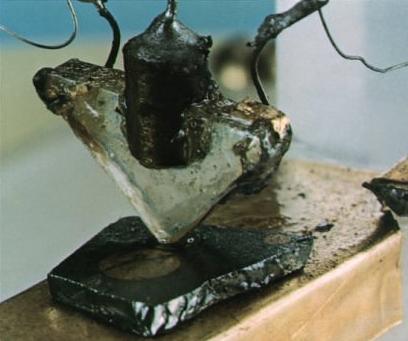
Personally, I Blame the Transistor

...or rather, I blame the transistor radio, cranking out newly portable tunes over those funky solid state electronics. The audacity of those engineers, I mean, really.

By shrinking the size and power requirements for signal amplification, they made it so you could truck those things around anywhere, getting them out of the staid family room into the car, away from Mom and Dad's watchful eye. When the Japanese got their hands on the technology in the early sixties, the price of a transistor radio dropped to $20 (less than an iPod in 2007 dollars), it opened the door to what companies needed to get filthy rich: high turnover of content, monopolistic control of its release, and marketing directly to young people. We all heard too much of the case against radio distribution in the Napster days, but in its time, radio put the idea of creating demand on the map.

Now, I like the Beatles, I really do. I like how their songs range from lightweight and happy, to lightweight and serious (like scowling kittens). Yeah, they wrote well, and I've even been almost convinced a time or two that they wrote brilliantly, and sure, they had an interesting group dynamic, and they moved along with their times, blah blah blah, but by the Jesus they were bigger than, they revolutionized music like George Lucas revolutionized science fiction. They repackaged old ideas with an admittedly novel spin and with broader range (than some), but I see their outsized legacy as much as a function of luck and timing than anything.

They had the indescribable good fortune of providing a product when America was hungry for it, lucky enough to have a manager who had already packaged it. They were just in time to take advantage of widespread youth-oriented radio distribution, and just in time grab the American television audience as the post-war generation came into consuming age. They had savvy marketers, and they were smart enough---and yes, good enough musicians--to keep updating their image and their material. They were fortunate enough to be white. Not bad for a good-time Hamburg bar band. But on the other hand, when serious people debate the genius of the gang that sonically smirked through "Love Me Do" with the bunch that harmonized "Help Me Rhonda," then maybe that's a little telling.

The fortieth anniversary of Sergeant Pepper's Lonely Heart's Club band passed without much notice from me. There was some necessary (and only somewhat eye-rolling) hagiography on NPR, the requisite contrarian (but surprisingly even-handed) Slate article, and you know, I was mostly okay with it. I mean hey, I wasn't there. But even gentle Keifus has a limited tolerance for hero-worship. It was good and all, but constantly calling it the most brilliant musical composition evah is a little tiring. When American Idol contestants hashed out the old legacy, it didn't feel inappropriate. (If AI is anything, it's about recapturing that radio distribution model.) This weekend my daughter's fourth grade class is singing Sgt. Pepper (the song) as part of their year-end musical show, and that seems to capture the happier spin the Beatles sought even behind their deeper efforts. Yeah, that suits me just right.

Keifus

P.S. You wouldn't believe what you can write a thesis on these days.

Wednesday, June 06, 2007

Entropy Production and the Best of All Worlds

[No, I don't really expect any comments. It's a pared-down version of my blog post, maybe easier to read. Less text means less text that's wrong.]

Chemical engineering has historically been a phenomenological science, meaning that it's more based on observed phenomena than it is built bottom-up from the sub-microscopic nuts and bolts of the universe. If you were to, oh I don't know, go to graduate school in the field, you'd find a good third of the curriculum devoted to Transport Phenomena, which describe the rate at which thermodynamic variables--momentum, thermal energy, chemical potential (and charge too, though it's not usually lumped in there)--dissipate along gradients.


The second law of thermodynamics states that entropy of a closed system increases toward a maximum. When you start talking about the rate of entropy production, how fast it increases, you've entered the field of non-equilibrium thermodynamics. That's a way of describing transport phenomena too.

Entropy is also interesting that it has a statistical (informational) basis, which is generally wiped out by the abovementioned phenomenological approach with its tendency to lump all that microscopic mumbo-jumbo together. It turns out, however, that just as phenomenology has a habit of washing out microscopic events, enormous systems-of-systems wash out details of the usual phenomenology. Interestingly enough, non-equilibrium and statistical approaches both appear to become very useful at this distant level. I've read some (public access) articles recently on the hypothesis of maximum entropy production for complex systems (such as weather, ecosystems, or economies) which states that a really complicated system will organize itself to dispel gradients in state variables in the most efficient way possible. The hypothesis appears to be completely baseless, but it has nonetheless been (evidently) successful in describing some complex phenomena, and suggests that the recurrence of certain structures in large systems is because they dissipate the great big energy gradients most efficiently. I hate the examples that these authors have used--phenomenological models describe waves and vortices and so on well enough--but to suggest that they can be interpreted as optimum dissipative structures is, well, interesting.

The question arises: is human evolution (genetic or social, take your pick) merely the most effective path that has so far developed to dissipate that huge solar energy gradient? You can see the danger of drawing out the cranks here, but just because speculation is silly and intellectually dangerous doesn't mean that it can't be fun.

People aren't at equilibrium (certainly not when they're alive), and neither is society. With the constant application of solar energy, we maintain at a roughly steady-state non-equilibrium condition. You can irresponsibly ask thermodynamics the same questions that philosophers have struggled with for millenia. Is human nature a development that, when averaged out, facilitiates entropy production, and does human organization facilitate it further? Is the nature of our ensemble developing over time, and do we waste heat better if we are brutal or if we are constructive? If we're happy or sad? Can it get better than this? Has it ever been, really?

Keifus

Some public access reading, if you just can't get enough:

  • Maximum entropy production vs. Darwinism (science reporting, easy to read)
  • Entropy production and life as we know it (accessible, but I found it tedious)
  • Hey man, quantum mechanics isn't dissipative. Where's the entropy? (big words and a little math, read 1/3 of it and didn't seem bad though.)
  • Fluctuation theory for small systems (from Physics Today)

  • Wednesday, May 30, 2007

    Mycophobia!

    Last week, I discovered an infestation of morels near my house. Well, OK, I've only found four of them, but if I were really motivated, I bet I could hunt around for enough to justify claims of a colony. I'm pretty sure they're the real deal: they're hollow, their caps are joined to their stems at the base (not the top), and they have a nice pitted and ridged crown. Here's a picture of one of them.

    It's a lovely organism, but the idea of putting the damn thing in my mouth drives me batshit. It's not that it's exotic-looking--not much worse than a cauliflower really--it's that the idea of eating weird-looking shit I find outside is wrong. I can look at pictures and field manuals all day, but until I see someone else pluck it, prep it, and pop it in his or her mouth, my stomach clenches at the very idea. Damn shame too, because I've always wanted to taste morels. [Twiffer says they're worth risking death for.]

    I want to blame evolution, but it's not the lowness of the lifeform that sparks the revulsion. (After all, I can't imagine a life without yeast.) I'll eat a lily bulb before a garden variety bug or snail, but I'll scarf a dandelion or a pansy from my yard before I start shaking out pine cones for nutty treasures (which I quite enjoy of course). And I eye those baby spring ferns with deep apprehension. I want to saute the curly little bastards, but...

    I'm an open-minded eater, but there are certain foods for which I hold an unreasonable horror. Partly it's because they're slimy and gross, partly because they just seem like they shouldn't be eaten, partly because they remind us of the animal nature of our dinners: tripes, brains, eyes. I can't imagine eating an animal's kidneys and I find the thought of sweetbread to be offensive, but I like calf's liver and heart. And I just love sausage. (Not like that, you pervert.) One time I had jellyfish, and even though it tasted like fishy noodles, it was hard to divorce my mind from the puddles of stinging beach goo. Seaweed tastes similar, but I've no problem with it. Lobsters taste good enough to get past the sea-bug vibe. Snails haul their big slimy foot awfully close to teh line, but I'll guzzle raw clams at the picnic. What's the difference? (The thing with the salt, for one.)

    One of the better parts of Michael Pollan's recent book, was a (qualitative) discussion of food aversions, the odd combination of learned and instinctive behavior. The role of learning in person, he says, is irreplacable--edibility is something that really needs to be shown. Maybe that's why, against all reason, the American mind doesn't revolt against a twinkie in the same way it does against, say, chicken feet. As usual, it's the marketing.

    Edible shrooms hold a certain freakish terror of their own. No matter how much I love some of the storebought varieties, I share the common human suspicion that yard fungus is deadly poisonous until proven otherwise (and even then, even then...). If I beat the odds and found (and recognized) a truffle, bet that I would chuck it horrified back into the trees. I'd make a second-rate survivalist. If I were suave, come the apocalypse, I could use those book-smarts to at least convince some tasters. Some people are made to be leaders, others to whisper in their ears. To my future band of ragged starving misfits: remember that I'm too valuable to kill. I can recognize a morel for you to try.

    Fonts for the Memories

    Slate had a pair of interesting (at least as far as these things go) articles on typeface* geekery today (here and here). The world of reading aesthetics is, not surprisingly, full of prejudice. For those people who can't go five minutes without thrusting endless rows of the things before their watery, myopic eyes, the presentation of words on the page or the screen matters a lot, and preferences worm their way in to the brain to imprint themselves somewhere just below the level of conscious thought.

    For reading, I've long been a fan of the Times typeface, or one of its dozen usual variants. I'm not super particular about it or anything, so long as it's something decently seriffed, stately, fully justified, and proportionally spaced, like in all of those half-remembered novels from my childhood--it's what respectable prose writing should look like, way more serious than the urgently penned capitals of my innumerable dogeared comics, or the vast and random array of ironically emphasized styles of MAD magazine. The aspect ratio might change a little in the book printing, the spacing, the boldness, but it was always something tall and gabled, a font bespeaking decency, old money, dignity.

    In those unheralded formative years of mine (after Led Zeppelin's peak and before Nirvana's, roughly speaking), sans serif typefaces had a certain unsavory meaning. They connoted a dated gosh-wow sci-fi (read "skiffy") feel, dusty and cobwebbed under the banality of actual post-Cold War modernity. They were the guilty pleasures of my parents' day, almost of my grandparents'. I'm grateful for the article's dissection of Arial as a streamlined, zippy-but-dumb Helvetica. Helvetica is the ubiquitous roadsign typeface, with a couple of curves and tails offering the reminder of the old-school sophisitication that had to be sacrificed in the name of clarity. Arial, by contrast, needs to have a rocketship underneath it. (Not that there's anything wrong with rocketships.)

    I suppose this opinion is thanks in part to my young computer experiences, such as they were. I remember those ugly all-caps early computer displays--a string of pidgin English, delivered in a shout, and followed by a block of a cursor blinking inanely at the end. I always peeked at those gray plastic boxes in fascination, but the promise of doing cool shit with one of them tended to dissolve in five boring minutes of effort. If the programming bug ever bit me in those days (or ever), I'd probably be rich now. I wanted to believe, but I didn't have the patience to become an early convert to the digital cult.

    Not that I ever got that far from the church though, even if I was a stranger to its deeper mysteries. I learned to type on one of these beasts, bought by my parents out of some sense of obligation to the times. Those Tandys were early advertisers of office utility (and the fact that the Radio Shack brand didn't have an underground network of pirated and swapped games had a lot to do with my parents' purchase). A lie, that. That machine had an evil and primitive word processing program that was already obsolete at the time of purchase. It could produce lower case letters though, and I remember the dot matrix recalcitrantly whirring out a barely legible mixed typeface for my school reports, some Arial bastard with Roman Is. My poor mother attempted to crank out a number of book manuscripts with that turd, perforated wheel guides carefully torn off, sheets separated and then lovingly packaged. (I transcribed one from its hard copy three years ago for her for Christmas, and keep meaning to follow through with the others). Mom never submitted in Courier (which I admit is a lot easier to scan by eye), but then she also never quite got anything published.

    Fast forward a little. In college, there was, of course, more writing. As an engineering student, I don't think I imprinted quite as strongly as a liberal arts sort might have, and anyway there wasn't any word-wrangling platform ubiquitous enough at the time to lock in my character aesthetic. (I got my degree in '94, as Bill Gates was still perfecting his stranglehold on office software tools.) There was a huge network of public workstations (unix-based I think), blessedly with laser printers. Sometimes I wrote lab reports on a program called Slate, but usually I just used a generic text editor. If I was running really behind (not uncommon) and didn't have time for the haul across campus, I borrowed my roommate's typewriter. There was email on campus (and it was new!), and I engaged in some other text-based nerd-tivities I'd rather not disclose. None of it used the tired zip of streamlined Swiss letters. They were all stately and decorated at the ends, giving my playtime the illusion of respectability.

    A lot of the writers interviewed in the Slate (magazine) article were annoying ("my preference of Courier means I'm better than you"), but I am not without my own pretensions. All of my accepted manuscripts have been for academic publications (not as great as it sounds, but pride baby, gotta have it). My graduate advisor insisted that everything be written in Times font for those because that's what the journals expected. I consider Microsoft's version of Times New Roman to be the graduation point of my writing efforts. I mean, I was (am) a second-rate scientist, but I could totally write circles around that guy.

    Maybe it would have ended there, but the internets were coming about at that time too, slamming me with that space-agey Helvetica ripoff all over again. Every online publication seems to use it, and it's grown on me, I admit (I mean, look around). It's tough to read anything for very long on a CRT, and simpler and bolder typefaces help ease the eyestrain immensely. I've gotten somewhat ecumenical in my tastes: different fonts for different haunts. Arial (or similar) for on-line reading or for presenting data, Times for prose, Courier to string up that Damocles sword of the rejection slip. I've never been much of a purist anyway.

    Keifus

    *Note to self: remember this site

    Wednesday, May 16, 2007

    Natural Labyrinth

    I was reading recently about the ideas of wildlife corridors. Conservationists have been floating the idea around for thirty years or more that the encroachment of habitat can be alleviated by--if large open spaces are out of the question--then by providing a lot of smaller spaces that are interconnected. When there is continuity between environments such that predators can roam, pollen can spread, even where species can migrate long distances, then the impact of human presence can be significantly reduced because the forest creatures are not uncomfortably cornered into shrinking squares of space. Wildlife corridors from Yellowstone Park to the Yukon and along tiger and elephant routes in India are being pursued (no doubt with varying degrees of ineffectiveness).

    It's been a (reasonably asked) open question as to just how successful these corridors actually are in preserving species and their habit(at)s. Last year, a study out of UCSB was published in Science (sorry, the link is a report of a report) showing significant improvements in biodiversity as they measured it in controlled swatches of North Carolina woodland. Evidently, that's the first quantitative report of the positive effects of functional connectivity, even though organizations have been acting on that hypothesis for a couple decades. Ordinarily it's the sort of thing that would really annoy me--the idea of pushing a policy based on speculation--but these are policies with pleasant side effects. Living close to minor, local versions of wildlife arteries has really improved my quality of life. The upside of my crappy neighborhood is the illusion of seclusion that exists here. The view from my back porch occludes most of the neighbors by a stand of trees along a stream. My daughter loves to play along it, and regularly drags her little sister and her neighborhood friends on expeditions "down the bank".

    The woods, such as they are, extend between back yards along two streets. If you go far enough upstream (not that far, but out of sight from my porch), there is a road to cross, but once you do that, you can meander westward behind the scenes until you get into a state forest. If you cross the street that bounds the east end of the stream, then you're in another sizable chunk of sparsely molested wooded area, cut through only with a railroad and a rarely traveled road or two (and dotted with official and unofficial landfills, and harassed by dorks on ATVs). I've seen deer, foxes, and coyotes that've managed to make their way along the mangy appendage of the state forest to my back yard.

    Here is a picture that I took on a walk with my daughter in December through the eastern half of the woodland dumbell. That hill you see was completely forested last spring, but it's being cleared for new developments. McMansions probably, judging from the neighborhood on the other side of the hill. The top of the hill is just short of the elevation you'd need to see the roof of the new Wal-Mart that is currently being built a ways down below. Can't stop progress. Maybe those people will work there when the balloon payments on their creative mortgages hit.

    If you were ingenious at solving those IQ-test spatial projection problems, you might enjoy crystallography as a hobby. Luckily for me, I was only all right at them, and I'm able to get my kicks from more primitive versions of morphology. (Whew!) One neat thing that's possible in three dimensions is bicontinuity. If you were walking along on the badly drawn monkey bars below (imagine an extended network of them), then you could get to any point in the cube. You could also do that if you were traveling in the space between the lines. A lot of bicontinuous structures occur naturally on a microscopic scale. Any system of immiscible phases can have this property, but you can also do cool shit with it on purpose. The picture on the right is a representation of an inverse opal, taken from somebody's presentation on photonic band gap structures. It's made up of the spaces in between close-packed spheres. You can actually fabricate microstructures like this in the lab by slowly depositing tiny glass balls from a suspension and then filling up the gaps in the "solid" with another material.
    I love monkeying with the philosophical ideas of bicontinous structures. A viable way to mix civiliztion and nature is one agreeable way to consider it, although as a practical matter, you need to add a third dimension of bridges for the bears and elk to cross the highways that cut through the wildlife corridors. But you can go more universal too. I'm pleased that nature may contain hidden but as yet unseeable dimensions, and I want to imagine networks of activity invisibly occuring in this weblike alternate continuum. We can map our brains like this too maybe, cognitive labyrinths of the human experience, something apart and yet intimately close to the inanimate network of stones and trees. It's even a fine interstitial universe in which to pretend spirits can cavort when the light is just right.

    Even if it's better that we mostly confine ourselves in the man-made phases, it's good to know there are others.

    Friday, May 04, 2007

    Five More Thoughts (Contrarian Bullshit Ed.)

    Some time ago, Demosthenes2 wrote a Fray post on three levels of thinking.* It was one of those that stuck with me, and I sure wish I could find a cite for it. As I recall it anyway, level one thinking involved sucking down wholly packaged ideas--usually without chewing--and regurgitating them loudly--often without provocation, at the dinner table. Having moved past dogmatism, the sophomore(ic) level two thinker lives to poke holes in every established manner of thought. Level three had something to do with mature independent blah blah something. That guy does like to go on.


    1. Contrarian Bullshit and Statistics
    The engineer in me loves to conflate mature analysis to number-crunching--not that you can't lie with statistics or dazzle with pie charts or anything--but low-level thinkers have a tendency to not really weight anything properly, to follow one possible chain of cause and effect and proclaim away as though it were the only important one. And some of the lying trends are sometimes falsifiable, which is a good reason to poke at them. If you don't have the time, and need a rule of thumb, however, the number of links in the causal chain is usually a pretty good depth gauge for the bullshit.

    Playing in the real world--or at least the sometimes verisimilitudinous worlds of policy and economics--means that all such chains are hard to follow because you can't control the inputs very well, and you don't understand the initial conditions (damn butterflies with their incessant wing-flapping). More, there are human casualties to the approximations. The fact that lives are quantized does matter, and while you can't account for all the anomalies in any analysis, minimizing the bad consequences of policy is as important as maximizing the good, as Claude Scales has suggested here. (Hippocratic policy beats hypocritical policy.) Acting on models of spherical, frictionless, er, humans with no external forces can have deadly consequences, and simplifying assumptions should be thrown around with great care of the context.

    But that doesn't mean that speculation and conjecture can't be interesting and fun. (Especially considering that otherwise it's "work".) Context, as always, is everything.

    2. Solar Desalinization
    Considering ensemble effects, the whole round earth is a fine place to draw a control volume. If you do a heat balance on the earth, you're really down to four effects: solar radiation absorbed, solar radiation reflected, heat radiated out to space, and heat energy generated at the surface. Your initial condition is the surface temperature at whatever time you call zero. (Since the temperature distribution across the ball of the earth is impressively not flat, it's probably better to draw your control volume as a shell, which means you'll have some boundary conditions too, at the bottom of the crust say: constant temperature or close enough.)

    Most people are aware that this is a good-enough way of looking at global temperature balance (some argument about all the factors that change the globe's reflectivity and absorptivity remains), but it's also a limit on how much energy is available to do stuff. There are really only two sources that are not finite: there's mining heat from the earth's mantle (that should last a while), and, whether it's biomass or silicon, there's solar. The cool thing (so to speak) about solar, is that it doesn't really affect the heat balance (unless there's enough spread out to really affect the absorption coefficient). It just gives that energy something to do on the way down its natural path. And what's life anyway, if not a pointless little whirligig kicked up in the dust of the universe's insensate march toward heat death?

    I was thinking about fresh water yesterday. Maybe that will cause more wars eventually than the oil will. Wouldn't it be great if we could efficiently desalinize seawater? Wouldn't it be great if that energy was completely renewable? Duh, Keifus: this one is already working, and adding technological steps may make it more controllable, but it sure ain't going to make it more efficient. If we wanted to increase the generation of fresh water, we'd have to lower the reflectivity of the oceans or something, warm up the...

    And you thought the butterflies caused trouble!

    3. Research and Development
    Solar sounds like a good place to sink our research dollars, eh? But who would fund that sort of thing? Having dabbled in the area (I'm supposed to be a professional researcher, my bosses would prefer me to be a professional negotiator, but dabbling in half-ideas is basically what I do), it's my understanding that there was a lot of venture capital sunk into solar power in the seventies, and the technology grew a lot of stigma because it didn't achieve much return very quickly. Plus, oil got cheap again.

    By common agreement, solar power needs to drop to about $1 per Watt to become competitive with fossil fuels, and for the time being, you're stuck with either low efficiency or expensive materials. (Ignore, for now, the matter of all that open space you need to gather it.) Cheap, efficient solar? Maybe possible, but at least a decade off, depending on the oil. You can still get funding for solar R&D: aerospace is a driver (you can't carry a jerry can on the back of the shuttle), and the commercial market's slowly getting grown. Looking twenty years out, you'd think that it would be a huge opportunity, given climate change and oil scarcity. Can we count on investors to think in quarter-century time scales? What do you think.

    What caused the decline of corporate R&D? Was it economic or was it cultural? Could Bell Labs have existed without a telephone monopoly? Possibly not, but I fear that the investment culture has become short-term (and the intellectual culture has devolved). It's as though that great post-war manufacturing and innovation surplus (that my parents' generation mistook for their deserved way of life) has been slowly cannibalized. Maybe it was inevitable, but it's an article of faith with me that we could have sustained the boom longer if we kept priming the front end, with a better eye on the horizon. Right now, basic R&D gets mostly funded by (1) the military (which doesn't do real basic at all) and (2) by universities, mostly on the government buck. Even though I'm turning anecdote into data here (hi, hipp), not to mention recycling thoughts (a five-trick pony, that's me), I've seen agreement among my more assiduous peers. R&D is a toughie for the level 1 and 2 libertarian types.

    4. Foreign owned: who cares?
    Oh, but by monopoly or luck, we once did R&D, and by the Good Ford, the U.S. was the king for a while there. It was pointed out to me yesterday that Toyota and Honda are the new saviours of the American auto industry. Evidently, our crumbling manufacturing infrastructure is desirable to those who'd like to develop new markets, and, I presume, the shipping costs are less if they're building cars for American markets in America (who else is dumb enough to buy SUVs en masse?). There's some yellow streak (not that kind) in me that's annoyed that this isn't being done by American manufacturers, but lets face it: 401k or no, I'm no member of the ownership class. I'm not the sort of person that can network his way to success. Sadly, I need a job.

    Income inequality is way up (look at the BLS). Level 1 market types say, "hey, the economy's growing, so stop whining," but even while profit creeps up, wages remain stagnant (anecdote + Paul Krugman), and CEO payscales skyrocket unconscionably. So if it's Toyota's providing the yahoos a salary or if it's GM, do I give a shit who the owners are? Not really. In fact, I feel a little kind of good about sticking it to the man.

    (Except that I don't think Toyota hires a lot of American scientists.)

    5. Electability
    Just for the record, I fucking hate politics, but since I'm speaking of oil and vision, wasn't there a guy running for office who actually faked caring about those things sort of convincingly? What was his name again?

    I thought Al Gore was all right. Sure, he was a dork (ahem), but he was a hell of a lot less innumerate than his challenger, more aware of the world, and, sighing or not, light years ahead on the articulation scale. Reading about his support for Iraq bombing in hindsight disappoints me, but still, he was the best Pepsi product I can remember. His wife was a scold, but I'd put up with her too if I were Al.

    So. Level 1 political thinking: it's the party platform, vote for the team, Yankees suck. Level 2: Supply side contrarianism, issues voting, and--wait--how does voting for the "electable" guy fit in? Is that bullshit too? Look, I supported Kerry in '04, and it was, like most Kerry supporters, not because I loved the guy but because I thought he was the least obviously flawed candidate. Saying that electability is bullshit is likewise bullshit. Electability ain't so much guessing what your fellow citizens will vote for so much as it is guessing who's going to go down easier with the media. The press will crucify the candidate who they can't imagine getting laid in high school. The electable guy or gal is the one that the reporters aren't slavering to deconstruct into a teenage clique. Gore in 2000 got hoisted as the moody chess champ against the avuncular high-functioning retard. No contest.

    So in 2008, who's the one most likely to going to sweet-talk the press and provide them free drinks? That's who's electable. And thus is the lowest common denominator reached.

    Good night, everyone.

    *UPDATE: D2 mentions that it came from an essay by William Golding (yes, that William Golding) called Thinking as a Hobby. I got the levels backwards (figures), but as our Greek friend says, it's definitely a good read.

    UPDATE2: Claude pointed out the link.

    Wednesday, May 02, 2007

    Easy there, Mr. Friedman

    Tom Friedman would be funny, if the stakes weren't quite so deadly. It's like reading the transcript of a psychoanalytical session:

    "Now Mr. Friedman, we'll do a little role playing today. Pretend you're the president of the united states, and you'd written a few dozen columns, er, speeches about Iraq's threat of chemical weapons and 'doing it right'. Unfortunately, it didn't go as planned. What do you tell the American people?"

    "I..."

    "Yes, you can do it."

    "I... was..."

    "Oh, very good, Mr. Friedman. Very good. Please go on!"

    "I was ...wrong. There. I said it."

    "Oh, very good."

    "I'm so sorry, America. He didn't have any WMD. He wasn't a thre--

    "Mr. Friedman?"

    "wasn't a th--

    "Nurse?"

    "wasn't a... wasn't..."tyranny! nihilism! car bombs! Islamists! Iraq! Do it right, do it right, DO IT RIGHT!"

    "Okay Mr. Friedman, that's enough for today."

    "heeheeheedoitrightdoitrightdoitright..."

    "Nurse!"

    Tuesday, April 24, 2007

    Baghdad Tech vs. Virginia Tech

    In the wake of sensational reports of violence, I wasted an hour or two yesterday playing around with casualty numbers and populations. A lot of fear has been used to sell this war, fear that terrorists might infiltrate U.S. institutions and wreak havoc. Not that it takes Al Qaida to do that, as residents of Blacksburg are recently quite aware. The spectacular murders there have put a lot of focus onto safety measures there as well.


    Here at Slate Jake Weisberg latched onto the "regularity" of school homicides, which despite his alarm, are quite rare, amounting to about 20 per between 1992 and 2005 There were about 60 million Americans between 5 and 19 (according the 2000 Census), making the rate of school shooting about 3e-7, on the order of a hundred-thousandth of a percent. A school homicide is nearly a hundred times less likely to occur than a murder in the American workplace, according to these data, which isn't too surprising, especially for the under 10 set. I've got a thousandth of a percent chance of being gunned down by a disgruntled someone at work in any given year. (Although maybe it's a little better than that here. Obviously I'm taking no effort to break down risk groups. It's a fucking Fray post.)

    By similar rough-order-of-magnitude reasoning, my annual odds of getting killed in a traffic accident are about a hundredth of a percent, or one in ten thousand. That rate is enough that in a moderately-sized community, it'll make for an impressive headline every couple of months when it happens to (hopefully) someone else. I take this as a good point of reference for risk assessment, call it the I-95 test. Driving on the highway represents a sufficiently low level of risk to my life that I consider it basically beneath notice. How does a homicide at school shooting to driving on the highway? My kids are a thousand times safer there than in the car with me.

    It's harder to generate a yearly stat on terrorism, of course, but unless the mushroom cloud is really looming, it's not high. Even considering only the year 2001, you had a better chance of having a skyscraper fall on you than having your office-mate go postal, but you were still 200 times more likely to die in a flaming car wreck.

    Over in Iraq, the odds of a civilian dying in combat are about 65 thousand/20 million/4 years, or about a tenth of a percent--a hundred times more likely to get shot by a soldier than I am to rack up my Subaru. The annual odds of dying there as a result of the war is over ten times higher than that, better than one in a hundred, and that's to say nothing of the kidnappings, threats, desperation, poverty, and general lawlessness. You are probably acquainted with a hundred people. That's like taking half a dozen kids from every school in the U.S. and putting a bullet into them.

    Recently, General Petraeus told the Washington Post that "Iraq is going to have to learn – as did, say, Northern Ireland – to live with some degree of sensational attacks." That comment is hard to swallow, considering the United States' overwrought concern about any sensational attacks is, approximately, how this excursion slipped through the congress.

    Yesterday's news also had an item about a bombing at the Technical University of Baghdad. The radio mentioned some 200 casualties there so far (trying to grab that one from memory, OK), and reports have, unsurprisingly, the Iraqi University system in shambles. The casualty rate may be exceeding 1% among what's left of the Iraqi intelligentsia, but people are still going to the University. (Of course, it's not clear their odds of survival are much different outside of school, and there can't be many other constructive ways to spend time, but still.) Would an annual 1 chance in a hundred of getting killed be enough to keep an American student from an American university, where the casualty rate is a more like 0.00001%? Is 1% annual chance of violent death something people can live with? A blogger (who knows who he is) got me wondering last week why the ants don't more often rise up. Maybe the answer is that a lot of people can bear those odds for a few years.

    Wednesday, April 18, 2007

    The Disapproval Network

    "You're such a whore, Phil."


    "Keifus! How can you say that? Dr. Phil is not a 'whore'."

    "Are you kidding me? Listen to him shill. What the hell is it this time? Some weight loss crap*? In the name of intervention? The dude's totally shameless...and not exactly the slimmest guy in the world, I might add."

    "I don't care. He's not a whore. Look at that little girl crying. You can't fake that sort of compassion."

    "Compassion? The knob's exploiting the poor kid's emotions on TV like that. If he really cared about these people, he wouldn't be embarrassing them on national telelvision. But you know, Sweetie, anything for ratings. The whore."

    For some reason, my wife doesn't like watching TV with me very much.

    I've got kind of a love/hate relationship with the medium. While I enjoy some television programming outright, I choose to apply a relatively high standard if it's purporting to keep my attention between the crass ad breaks. I'm for a free market (with some big caveats), but that doesn't mean that I'm not bloody tired of all the consumerism jammed into every goddamn crevice of my life. I hate the way TV shamelessly angles for the susceptible: those primetime ads at least attempt to entertain me between the allegedly superior programming, but children's telelvision, and the crap on the emotion-pandering-on-the-cheap world of daytime TV just offer up a barrage of inferiority complexes. So when I'm stuck in that hell, I take every perceived opportunity to unleash my inner prick. You know, make my own entertainment. And anyway, Phil McGraw is a fucking whore, and deserves to be called on it.

    My libertarianism is more of a pursuit-of-happiness than a laissez-faire stripe. I'm all for that free speech, and for as little government power over individuals that can leave an overpopulated society still functioning. The government will make no law abridging the freedom of speech, but communities can still pressure people to behave, and national television makes the network homogeneous. The TV lessons range from acceptable (friends matter!) to sketchy (love the cops!) to awful (the solution to violence is more violence!). Since we have shit that needs to be peddled and TV, even with cable, is a broad brush, we get the lessons most easily absorbed by the most, and it reinforces the values of the dumbest of us. Sex is bad, says the tube (but we can't get enough--what are our neighbors doing?!). Ditto killin' people. Ditto our opinions on who's not to be trusted, and who can't be punished enough. Don Imus didn't survive this long because he had a good radio voice. He got adopted as some brand of jowly bullshittin' culture reinforcer, a dinosaur remembering the semi-mythical good old days when the uppity mice were kept away from the eggs.

    Dr. Phil's message could be worse, I suppose. Self-actualization is one thing, but I could do without the busybodies chasing around the poorly actualized. One of the more odious Dr. Phil guests is a retired detective, who spies on and professionally confronts people. The segment I remember showcased a teenage bride in a sketchy (possibly illegal) relationship with an older man. The camera followed the citizen police into the home, caught his shouting match, filmed him dragging the young woman out to the car. Meanwhile, the mother tearfully milked the Nielsens back in the studio. It worked out well for the young person. On camera it always does, but how many wannabe citizen soldiers have been heartened to bust the doors down on nonconformists?

    If the free market means that I have to put up with marketing, then the free exchange of ideas means that insecure people will constantly try to shame you with their loud voices. Good arguments wouldn't rule the day even in libertarian la-la land. Even then we'd have to listen to the chorus of the disapproval network. And don't get me wrong, it's not conservative ideas about community that I'm attacking here (although I'll happily single out a couple of 'em if pressed), but rather the means of reinforcement: by peer pressure, by accentuating insecurity, by barrage.

    The prices of freedom, I tells ya.

    K

    *It was probably something else last time I was watching, actually, but the diet aid dominated the Google search. Phil-endorsed Shape Up! supplements were something he was actually called on by consumers. The handful of shows I watched had him hawking either his books or somebody's self-help or emotionally-sanctifying product of some kind. In Phil's defense, the books are a lot less bad than the television.


    Thursday, April 12, 2007

    Pregnancy TV?

    I read a Slate article today. Evidently, there's a pregnancy-themed sitcom on ABC in the works.

    It sounds absurd on the face of it, right? A woman's pregnancy will only get you through a season of programming, unless you take a truly weird take in which she's eternally preparing her nest, or has a new one just in time for every sweeps week. It's not a cartoon: sitcom kids aging is part of the deal.

    But it's not like focusing on a year in the life is an unusual marketing ploy. To move all those beauty supplies, consumers are pursuaded to twist themselves to a mythic ideal of an eternally 18-year-old body. Gotta convince the tweens they need to look older, convince the twenty-somethings they're too fat and wrinkled and the forty-something men they should still be rutting like rabbits (note to self: re-evaluate on 40th birthday). (Of course developing all those products takes chemical engineering as much as advertising, so I guess it's nice that something's driving the economy these days.)

    We pass through those famous couple of years hardly realizing it, even those of us who are pretty enough to achieve the body ideal. Even shorter than the traipse though the adult/teen threshold are those ten or twelve new baby months. Yeah, the passage takes about as long, but the magic rubs off a hell of a lot quicker. Without marketing, the saccharine thrill of being new parents evaporates completely by the time Junior finally starts sleeping through the night. Sure, people may have more, out of biology or carelessness or love, but I don't think most second-time moms get pushed into spending a fortune on this stuff. (I could be wrong.)

    But there's a whole pregnancy industry, a bizarre time-like loop that exists betweeen the moment you find out the blessed news and the time you decide you're sick of midnight feedings. There are pregnancy magazines, pregnancy books, pregnancy party supplies, and baby registries full of endless pregnancy products. It's a pregnancy lifestyle that they push. The magazines are surreal. Covers of celebrities shooting across the sky in their moment of pregnancy fame, doing their gravid photo spread. It's a lifestyle that no one lives in very long except for the editorial board. Maybe if they push it hard enough, women would want to get pregnant again just to relive the magic.

    Can Underbelly last as a sitcom? They'll have to either get an audience of well-conditioned pregnancy groupies, or else replenish the demographic every couple of months. I'd call it an insane strategy, but outside of television, there's a pretty good record of it working.

    Keifus (meh. I tried to make it interesting)

    Tuesday, April 03, 2007

    Five More Thoughts (Psycho Smart Ed.)

    Don't be threatened by the title, this post is meant to be about smarts, and believe me, it's meant to be ironic. If it makes you feel any better, you can snicker to yourself about the brilliance I actually display--it is mostly about me after all--but I'm aiming for unseriousness here. So what if it's Tuesday.


    1. Brightness, after all, is a curse. I'm doing okay in the faculties department, at least relative to the general population, and in some rare cases, I even know when to shut the fuck up to avoid looking like a dolt. But I'd so much rather be a genius. It would make life so much easier.

    Certainly, I'm no physical genius. I'm okay at some sports (and miserable at others), but certainly I'd be unlikely to achieve a competitive level even if I wasn't too old. Never had that killer instinct anyway. I play music, but even though I can bang out a tune, sort of, I can easily project an arc that has an asymptote well short of art (best I can hope for is a stuttering voice, which as it happens is good enough for me). I always wanted artistic skills, but even more than the music, my pen yields sketches that at best are "identifiable." In high school, I was bright enough to skate entirely, and even college required only select applications of effort. Grad school killed me though, as it was evident that I'd reached a level at which real study was required. If I were a brilliant scientist, then I'd have breezed right through that and right through a post-doc, publishing with reckless abandon, really making a mark. Even though I've managed to milk an occasionally clever streak, for most of my career I've had to slog hard for nuggets in order to succeed. Unfortunately, I'm not a genius of self-motivation either. No, there I'm totally retarded.

    It's good to be a all-around above-average type and all, but I'm jealous of brilliance. I'd settle just for something really cool to stand out from my peers. I suspect any one of you I can point at can multiply big numbers on demand, read 200 pages per hour, recite the most obscure trivia, woo women (or men), aim, make the hard sell, memorize long numbers, perform convincing sleight of hand, bend your joints backwards, play brilliantly by ear, put people at ease, hold absurd amounts of liquor, find level and plumb by eye, bloviate. With six and a half billion people in the world, people with distinctive brain skills will rise up and concentrate to a high degree to the somewhat better levels of discourse, and stumbling awkwardly through them myself, I keep bumping into all you damned savants.

    2. Well, maybe one thing I can claim is some minimal writing skill. One way I deal with my essential laziness at work is that when my schedule is full of desk tasks, I can crank out reports and proposals in a third the time that anyone else can, leaving me lots of time to scrawl crap like this.

    Right now, I have a big one going on. I shouldn't be anywhere near the blog, but one thing about getting into a writing mode, is that it's actually hard to stop. I love it when my brain's in high gear--wish I could do it at will. When I go to bed tonight more words will be chasing each other around my skull. It'll stop when I get tired enough.

    3. My older daughter keeps a journal for school. It's designed to keep the children in form for the writing assessment part of their evaluation testing, but it's cool, it's a good project, and my little girl--child of two engineers--is pretty good at it. I was looking through it recently, and here's what she had for her November entry:

    "I'm thankful for my dad because there are already two monkeys in the family, and it's good to have at least one real person..."

    Like any good father, I take every opportunity to compare my kids to lesser primates, but to tell you the truth, I don't find actual monkeys (by which I mean apes--chimpanzees--monkeys are more like squirrels that can smile) very funny at all. Staged simian hijinks always seem a little sad to me, the underlying coercion doesn't escape my notice. But the Platonic "monkey" is still pretty amusing though. The pure essence of monkeyness spends lots of time masturbating, chattering, and flinging poo. Comedy gold.

    Amusing. I sometimes like to believe that I have muses. All those voices in my head, it's a barrelful of monkeys in there. Fun like that, and with a lot of flying turds.

    4. That last thought was pretty shamelessly recycled, but I'm gambling that anybody who's gotten this far (either of you) didn't catch the original. If you're all tired of that thought, consider it scribed for posterity then.

    We all have our own series of little performance routines, but depending on how big's your repertoire, how much you change it up, and how skilled you are at singing it, it can grating over time for anyone. One of the few upsides of meeting new people is the prospect of a fresh audience. Last week, I had such an opportunity, to meet some long-lost offshoot of my in-laws' hopelessly complicated family tree. It was fun to see my wife's parents pull out their classic material--hadn't seen it in quite a while ourselves--and be reminded that some people are best when you first get to know them. (A problem with knowing people for a long time is that you lose energy for the fun dances, or else you try your friends out as a focus group for dangerously untested material.) It was great to see them spewing out mock-philosophy with friendly enthusiasm, and just to see the general animation. Naturally, I held myself bemusedly above the fray, benignly aloof, accessible just outside the clamor. That's a big part of my act.

    5. It's funny how we meet people, what with the few degrees of separation and all, contrasted with all the billions of us. I know I've read this before (probably from one of you crazy savants) that even if we find one person in a million worthwhile, that still makes for a handful of hundreds right here in North America. Blogging, and upon a time Fraying, it's like I'm chipping away at the several hundred who have similar interests and mindsets. I link to X bunch of people, who connect with Y, who… One drawback to this model is that folks like us probably pop up a little more frequently than in the ppm range.

    But say there's a couple thousand that, by criteria I don't entirely understand, I'd really rather get to know, and a good couple million that I wouldn't mind in my general circle. It can't be done. Even with the help of the internet, our little communities can only reach so far. Couldn't even hope to meet a signifiant fraction of them.

    This drives me batshit. In a way, it's like everything I've ever tried to organize. You'd really like detailed information for every entry, with proper cross-references, and detailed notes for all. In truth, you really end up filling those things as they're relevant. If there's anything that keeps me from going over the edge into obsession though, it's a profound sense of "good enough," call it a fundamental laziness or else call it (as I prefer) a measure of wisdom to be content in the first local minimum that's pretty comfortable and has a reasonably good view. Even though this makes me a poor carpenter and scientist, it does keep me more sane. Even though there's a maddening sensation in the back of my mind that so much is always left incomple