Sunday, December 02, 2007

More on Saletan

Saletan asks us to consider a thought experiment in which biological differences make for difficult social choices. The critique of Saletan that makes the most sense to me, and that he does not appear to engage, is that our understanding of biology is already social. It's thus hard to imagine a scenario in which differential/unequal treatment of people would be preferable to a rethinking of our biological categories.

My thought experiment: imagine a world in which social status is based entirely on height. Height is very clearly a biological difference. Tall people could claim that there are any number of areas in which they were biologically superior, in part because they lived in a world devoted to the betterment of tall people. They could even come up with mythic reimaginations of human history in which (for example) reaching the farthest branches had always allowed the tall better access to food, superior living conditions, etc, etc.

Now, I happen to be not especially tall. What counterargument is available to me? The tall have biology on their side -- height is a function of genes. But of course, the real biological difference does not have to correlate to social hierarchies. Hence the argument of the short -- that biology is not destiny, that there are other imaginable worlds that have been systematically not imagined -- that have been discarded or not thought of -- because biological categories have naturalized social inequality.


Surely a just society is one that finds the best way for biological differences to be advantageous to all concerned, that finds opportunities for both short and tall. An unjust society is one that allows prejudice to shape scientific categories, thus justifying discrimination.

Saletan's a smart guy, and I'm sure he understands something about the history of science. I'm sure he thinks (probably correctly) that the fray criticisms are too strongly shaped by current culture wars. But it's not like the categories Saletan uses are any more immune to culture. Surely the history of scientific ideas of race is so horrific that we are justified in being particularly cautious.

Two side points:

1. Any genetic difference is really a difference in phenotypic effect, and those differences in phenotype depend on environment. A gene for digging, for instance, icould easily be a gene for digging when you are on the ground, and splashing when you are in the water. The nature vs. nurture debate is thus a false dichotomy. It thus makes sense to think of "genetic" inequalities as a result of the environment in which the genes express themselves. So even if we take Saletan's thought experiment in a naive way, and conclude that people from Antarctica are genetically more intelligent than people from the Arctic, then surely the appropriate response is to change the Arctic environment such that the phenotypic effect of the genetic difference is not so stark as to create permanent inequality.

2. But I don't particularly want to grant Saletan even that naive interpretation. I just don't believe that there is a truth, out there, independent of our categories of perception. "Intelligence" is a creature of our own manufacture. We made it to serve a purpose in the world -- education. If people are not being educated, then we need to create a different concept that will allow us to order the world in a more equitable way. That seems to me the thrust of much of the disagreement with Saletan, and I don't see how he feels justified in brushing it aside.

Friday, November 30, 2007

An Easy Way Out?

The flap over the "Created Equal" series of columns, for some reason, reminded me of an earlier stand alone Human Nature column. Back in March, William Saletan wrote "Mind Makes Right," about a study published in the journal Nature. I found this study interesting enough to mention it on Nobody In Particular, and I suppose that it's lingered in the back of my mind ever since. But thinking about the challenges of egalitarianism in the face of arguments over inequality, it came back to the forefront.

Scenario 12: Lifeboat 2
Mean emotion rating: 5.1
High-conflict
You are on a cruise ship when there is a fire on board, and the ship has to be abandoned. The lifeboats are carrying many more people than they were designed to carry. The lifeboat you’re in is sitting dangerously low in the water—a few inches lower and it will sink.
The seas start to get rough, and the boat begins to fill with water. If nothing is done it will sink before the rescue boats arrive and everyone on board will die. However, there is an injured person who will not survive in any case. If you throw that person overboard the boat will stay afloat and the remaining passengers will be saved.
Would you throw this person overboard in order to save the lives of the remaining passengers?
"Damage to the prefrontal cortex increases utilitarian moral judgements" - Nature
What makes this scenario interesting is that fact that the injured passenger is going to die, no matter what you do. If you push them overboard, they drown. If you leave them in the boat, it sinks, and everyone, including the injured passenger, drowns. And depending on how you read the scenario, even if the rescue boats were to show up right at that moment, the injured passenger is going to die from their injuries.

According to the Nature study, certain damage to the prefrontal cortex increases the chance that a person would state a preference for pushing the injured passenger overboard, saving themselves certainly, but also saving each and every other person in the lifeboat with them. Nature's researchers concluded that absent this damage, people are more likely to chose a "moral" solution (in this case, everyone drowns) to a "utilitarian" solution (the fatally injured passenger drowns, but everyone else survives). Put another way, "normal" people are commonly unwilling to make a determination that the fatally injured passenger's life is worth little enough that it is appropriate to sacrifice them to save everyone else, even if the alternative is effectively mass suicide.
"What really interests me [... are] the things at which we as a society will grasp in order to justify pushing people off the boat."
Dawn Coyote
Whatever the reason, Malthusian scenarios and people's sense of justice do not mix, and conflicts between the two often conspire to make people cowards of a sort. People either flee difficult decisions or look for ways to make them easier. The injured passenger on Nature's sinking lifeboat is guilty of nothing outside of bad luck, and it feels unfair to push them overboard, even when everyone else's life depends on it. And so people have difficulty in persuading themselves to do so.

Perhaps this is the root of the recurring attempts by this tribe or that nation to establish an "objective" hierarchy of relative human worth, sometimes based on laughably shallow and/or imprecise criteria. It may be a dirty business, but if it's based on "facts," then it can be argued that there is no self-serving bias involved. The results may violate one's sense of propriety, the argument goes, but they represent the "truth," and perhaps even reflect the order of the universe, or, at an extreme, the will of the divine. People may not put themselves in the very first spot, to avoid the appearance of outright bias, but you can be sure that hardcore hierarchicists are going to ensure that they make the cutoff when the hard choices have to be made. In this degree, bigotry allows for scarcity and justice to go hand-in-hand, by placing the difficult decisions in the hands of facts.

Maybe the reason why we grasp at reasons as a society, is that it frees us from having to make these judgment calls as individuals.
"No, we are not created equal. But we are endowed by our Creator with the ideal of equality, and the intelligence to finish the job."
William Saletan "human nature: Created Equal - All God's Children"

It's understood that the ideal of equality doesn't mean that we all die together. We would hope that it aspires to a state where people don't make decisions based on narrow parochial and emotional interests; acting to advance preserve themselves, people they identify with, and people they like at the expense of others (whom they conveniently label as undesirables). That level of enlightenment is a laudable goal, but given history up to this point, it's clear that we need at least one backup plan.

I would postulate that short of universal enlightenment, the greatest tool that equality has at its disposal is plenty. While there are assholes who just can't stand to see other people happy, most of us, when our own bellies are full, have no issues with other people also eating their fill. Debates over whether it's the gifted students or the developmentally disabled who should get the lion's share of resources fade when neither group has to go begging. True, there are people for whom everything just isn't enough. There's always another multi-millionaire who feels that they need to steal what others have to feel complete. Quietly lock them away, and make sure they get their medications, while the rest of us go on with taking care of things. So rather than be allow ourselves to be locked into a hyper-competitive Malthusian disaster scenario, perhaps we're better off working to see if we can make the pie large enough to go around.

Just as useful, if a somewhat more difficult tool to cultivate, is a simple acceptance that sometimes, life isn't fair. Justice may be the bread and butter of legal scholars and activists, but its not something taught in physics and biology classes. Inequity aversion may be hardwired into our brains, but inequity avoidance isn't always possible. Sometimes, there really is no choice except for someone to go overboard, and there's no just way to decide who it is. Not dealing with it doesn't change that, so the best thing to do is to be as prepared as possible, so that such dire straits are few and far between.

Wednesday, November 28, 2007

Extraordinary Machine - 3

It's very late and I'm wide awake, propped up on some pillows in bed with my new MacBook Pro. I'm still familiarizing myself with Leopard. It seems like there's some dazzling new discovery around every corner. I've got Thievery Corporation playing in iTunes, and everything is cool blue and silver, just like in Heaven. I know this is crazy, but this computer—I feel that it loves me.

Real moonlight, full night moon, variable moon, daylight only...

I'm trying out some new software. I've got the EarthDesk demo installed and it's very pretty, even though it says "NOT LICENSED - Evaluation Use Only" right across the African continent. It reloads the composite satellite image of the planet as often as you want, and it will render in a number of different formats, but even though it follows the rotation of the earth, it's still just the same desktop image over and over. Even toggling the options, it's not going to get much more interesting. I'm not inclined to spend money to keep it.

A copy of iLife came installed on the computer, but if it hadn't, I'd pay the $78 to buy it, merely for the iPhoto upgrade, although Garage Band is cool, too. I used it to record a CBC radio broadcast that I had running in Quicktime. And here's the thing that's great about Apple: whatever way you can think of to do something, more than likely the programmers have thought of it, too. I had never even seen Garage Band before, and three minutes after launching it I was recording live radio in it. That was encouraging. Maybe I'll learn to podcast.

I'm on the fence about MarsEdit. It's a handy little program for composing and uploading blog posts. Though I like its simplicity, its features are quite limited. The preview feature is nice, and the idea of having all my draft posts stored in one location where I won't forget about them is tempting, but I think the next generation of these will be much improved. I can't figure out how to insert an image into a post. If it was an Apple program, it would be readily apparent how to do something like that. I have yet to try to upload a post from it, but I'll try it out with this one and see how it works.

[edit: it worked well. Okay - I'm off the fence.]

One program I am going to pick up is Mindmap Pro. It provides you with the means to create a graphic map of your ideas with little more effort that it takes to make notes. In fact, it makes notes for you, putting your mapped ideas into a structured outline that you can use as a template for your writing. I test-drove it by making a map prior to writing these three posts, and that convinced me that I'll get good use out of it.

Okay—I saved the best for last: Apple Mail—the most sublimely simple and beautifully designed mail program that ever was. It's streamlined to perfection, with all the little details taken care of out of view. There is nothing about this program that annoys me. For instance, I am so over bouncing icons that alert me to new mail. Now when I get mail, a pleasant electronic purr sounds, and a number appears on the icon in the dock, indicating how many new items are waiting. It's all very civilized. Although there are many ways to manage incoming information, search retained mail, activate items in iCal, and even leave oneself notes and to-do lists, there are no extraneous functions to clutter the thing up and provide me with details I will not stay on top of. On the other hand, you can handily add in all the extra functions you want.

I've got you where I want you.

Photo 8.jpgMy favorite feature allows me to put the RSS feeds for all your blogs into Mail, so that new posts and comments show up in my mailbox promptly after you post them. Each feed comes into its own separate file in the inbox, but if I place all the feeds into a folder, I'll get an aggregate of all the blogs that I can access with a single click. I used to have a hard time keeping up with what people are posting, but no more. Now it all shows up on my doorstep. This does take some of the joy of discovery out of it, but the added consistency and convenience make it more than worth the trade. In addition to the blog feeds, I've got BOTF and a few other Slate locations tucked into another folder. Best of the Fray posts are even stranger this way—like alien missives when they arrive, anonymousely, in my inbox. If I can bring myself to read one of them, I will try to guess who wrote it. I'm about half right, so far. They're no more readable here than they are on BOTF, but my guessing game is mildly interesting. I only wish I could assign those posts the alert sound that resembles an electronic fart, but it's one sound for everything, alas.

I just love that I get alerted to whatever you post shortly after you post it. I imagine that if I turned the alert sound up while I was taking a nap, the notification would wake me up. I can get my Mac to read your posts to me, too. I tried it the other day. It was fun. I might do that some more. I could run through all the different voices and pick a unique one for each of you. It would almost be like you were reading to me, wouldn't it?


[the pictures of me in these posts were all taken with the MacBook Pro's webcam]

Tuesday, November 27, 2007

Whiskey Tango Foxtrot

Porn? Evangelism? Nope. Whoever snagged my old blog is flogging coffee. I totally approve. And John? I'd never have seen it if the URL wasn't still in your blog feed, so thanks for putting the feed back into the Wikifray sidebar.

Extraordinary Machine - 2

I'm lying on the couch, half asleep, with Sweetpea stretched out across my lap, and I've got my new Apple keyboard propped against him as I write this post. He doesn't seem bothered by this, which is testament to the graceful unobtrusiveness of the device's design. If this keyboard were a human being, it would be a young poet. It's amazingly thin and sensitive, and it connects wirelessly to my laptop from up to sixty feet away. Like the keyboard, the wireless Mighty Mouse is blue-tooth enabled, with laser tracking and state-of-the-art functionality. Honestly, though, the mouse, nice as it is, has nothing on the laptop's trackpad, which gives me the ability to move the cursor, drag and drop, double click, and scroll horizontally and vertically, all by tapping or sliding one or two fingers on the flat surface. I've got all the options turned on, and the settings set to their highest sensitivity, so I can practically just breathe on the trackpad and it does what I want. I also purchased a cable that allows me to hook my laptop up to my television and turn it into a second desktop upon which I can manipulate objects via the wireless mouse and keyboard. Do I need to do this? Of course not, but it will come in handy if I can convince my brother to teach me Photoshop. Peering over someone's shoulder is not the optimal way to learn, or to share things one is working on, or reading online.

I also picked up a little microphone accessory last week that pops into the bottom of the iPod Nano, and now I'm speaking into that, recording this post instead of typing it. I'm still lying on the couch with Sweetpea stretched out on my lap and the keyboard propped against his butt. He's snoring quietly. The laptop is on the coffee table beside me and the bluetooth mouse is on the couch by my hip. Scooter's sitting on the table, observing the scene with an expression of mild disdain, but I am not the least bit ashamed of my self-indulgence. With the flexible stem on the mic, I can prop the voice recorder on my chest so I don't even have to hold it, which is great because at the moment, holding it seems like entirely too much trouble.

All I need now is a blue tooth phone that will sync with my mail program, and maybe a telescoping arm that would suspend the MacBook above me as I lie here on the couch. Other than that, I'm well equipped. I can even go out in style: I have this big square Calvin Klein shoulder bag that my mom gave me for Christmas last year. It's grey satiny fabric with silver leather straps and accents, and it matches my laptop as though it were specifically designed to carry it. At some point I'll need to pack my Mac up and go out, but right now I'm too sleepy to go anywhere.

If only I had voice-recognition software that would transcribe this recording into a word document, but alas, I'm going to have to do that myself. But not right now. Right now I'm just going to lie here and flirt with sleep until it either overcomes me or gives up and goes elsewhere, and even then, I probably won't get up. In fact, if I didn't have to get up to eat or go pee, I think I could lie here forever. If I got bored, all I'd have to do is pick up the tiny laptop remote and open Front Row, the sleek new platform for accessing iTunes, iPhoto, DVDs, and video. I could watch a DVD or listen to a lecture without hardly moving a muscle, and since my brother has hooked up my stereo so that I can run iTunes through it, I have access to good-quality sound—not that my little Bose earbuds are deficient, but you can only wear those things for so long, and I'm going to be here a while. If I get lonely, I can get on iChat and visit with a friend. If I want to send an email, I can type it on the little keyboard, and even take a picture of myself to send along with it, without even getting up to get my camera, without getting up at all.

Wow, it's really freezing outside. I can feel the chill from here. If I could, I'd bribe someone to come and put on a fire. And perhaps as long as they were coming to build a fire, they might bring me some movies. And a four-shot latte. God—I'm sleepy! It must be winter. I could stay here, cocooned like this, for the duration. I have a huge jug of protein powder, a box of mandarin oranges and a dozen packages of ramen noodles. That should keep me for a while. I don't need to leave the house. Sleep is pulling me down. I'm hibernating.

Monday, November 26, 2007

Extraordinary Machine - 1

Although my seven-year old Mac Pismo had proven perennially expandable and well nigh indestructible, it was having trouble keeping up with its younger siblings and it wouldn't accept some of the new software upgrades, so on Friday evening two weeks ago I stopped by the Mac store and got a shiny new 15" MacBook Pro.

A new Mac! Too excited to wait until I got home, I opened up the box while I was waiting for takeout. As people around me were wolfing down their messy chili fries and poutine, I removed the styrofoam biscuit and slipped my new laptop out the envelope of soft fabric that enclosed it. The packaging was sleek and functional, but I wouldn't have been surprised to find the device tied up with colourful ribbons or folded inside a large square of silk, like some sacred temple artifact.

The brushed aluminum surface was like cool satin under my fingertips. I touched the button on the front and the cover popped open as if eager to grant me entry. I pressed the power button and the screen came to life in a fan of aurora borealis colour over top of a black, star-speckled backdrop. An ambient groove played over the small speakers, welcoming me to the Leopard experience. I stroked the silver keyboard and trackpad and felt something akin to religious awe, as if in those moments a small cluster of winged sylphs had emerged from the machine and now hovered in the air above my head.

And then my food was ready, and I hastened to put the computer back in its box and collect my order. At home, after dinner, the machine led me through the set-up procedure and I completed forms with my personal information. Suddenly my face appeared in the on-screen window and the set-up assistant instructed me to press the red camera icon. When I did this the screen flashed bright white. The assistant asked me if I wanted to use the resulting photo on my profile. "Sure," I said. "Why not?"

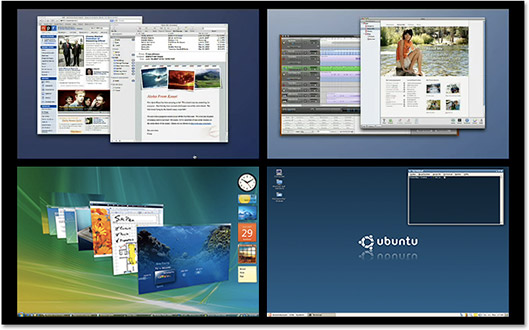
Once the computer and I were properly introduced, I set about familiarizing myself with the new environment. Among the many new features included in the upgrade, Leopard introduces some fresh solutions for organizing your work. Mac users no longer have to wade through a desktop cluttered with downloaded files, or find that they've lost track of their primary task under a pile of open application windows. In Leopard, the workspace is fluid and flexible. It expands, breaks, slides, flips, pops open and folds back up again. Apple has always been known for creating intuitive and redundant processes, and 10.5 maintains that tradition: you can access different views by mousing into the corners or the edges of the screen, by selecting items in the dock, by mouse clicks and by F-key commands.

Two new features provide novel ways to manage files and workspaces: Stacks sit in the Dock, and with a click they pop open vertically, revealing all your downloads or documents in a long chain. Spaces allows you to multiply your desktop and put different groupings of work on different desktops. To move work around between desktops, you just drag it from one space and drop it into another.

Except for the addition of a reflective silver platform, the Dock is the same, but the Dashboard is new. Dashboard is Apple's answer to widget-based user-built spaces like those offered by Firefox, Google, Opera and Netvibes. And as usual, Apple does it better: not only can you create your own Dashboard widgets directly from Safari with a simple clip and drag, you don't even need to open a browser to access your widgets for Wikipedia, Google, Calendar, Mail, YouTube, iTunes, Movie or TV schedule, Weather, Calculator, Yellow Pages, and many others. Clicking on the speedometer icon in the Dock brings your custom Dashboard to the forefront, overlaying and dimming other items on your desktop. Another click and the dashboard slides away, leaving your desktop as it was.

Time Machine is a automated back-up function that makes copies of all your files at regular intervals and stores two weeks of changes on an external hard drive, so if you lose something, you only have to scroll back through Time Machine's chronological files to locate the version you need.

The updated Finder adds a graphic preview feature that shows the contents of a file sliding across a mirrored black stage. Each image or document or application appears in miniature and takes its place in the spotlight when you scroll to it or click on it. This allows you the convenience of viewing the contents of your file in the Finder window before opening it up on the desktop.

This brief review covers only a small part of the magic that is MacIntosh. Stay tuned for part two, coming tomorrow.

Monday, November 19, 2007

"Values voting" in Australia?

According to this article in today's New York Sun, the Australian Labor Party, led by Kevin Rudd, holds a solid lead in the polls over the Coalition led by incumbent Prime Minister Howard, with only a few days left until the election. This lead, the article says, can be traced back to a surge of Labor support following a visit to New York by Mr. Rudd, in which he and Col Allan, the Australian Murdoch protege who edits the New York Post, went out for a night of heavy drinking, culminating in a visit to Scores, where bouncers threatened to eject Mr. Rudd for touching the dancers and other "inappropriate behavior."

There's a great animated comment on this by Nicholson in The Australian, here.

Evidently, "values voting" Down Under can have different implications than it does here.

Sunday, November 18, 2007

Inequitable Creation

William Saletan has started a new series in Human Nature, titled "Created Equal." In the first installment, "Liberal creationism," he lays out, with supporting facts, his basic argument that differential evolution has lead to an uneven distribution of traits between various racial/ethnic groups. Certain groups are better at certain things, or their bodies work in different ways, because prehistoric conditions favored those developments. So everybody has their strong suits. "Not that that's much consolation if you're stuck in the 21st century with a low IQ," he says, during the wrap up.

Now, I like Mr. Saletan, and enjoy reading Human Nature, but sometimes I think he completely misses the point. I think that he should have said: "Not that that's much consolation if you're stuck in the 21st century with a physical resemblance to the low IQ group, and the high IQ group decides that during a shortage, it's looks, and not test scores, that govern the food rationing." This is what William Jennings Bryan meant when we spoke of "'eliminating the weak,'[...] and undermining 'the sympathetic activities of a civilized society.'" And this is what's really at stake with the constant bickering over who's smarter than whom.

Human dignity means little in the face of famines, epidemics, wars or even simply high unemployment; and when people are needy (honestly, or just in their heads), they search for reasons why they, and the people they care about, should be the first (and sometimes only) ones in line for resources. (And, let's face it, most of us haven't done anything that would get us to the head of the line on our own merits. Thus the tendency to attach ourselves to the coattails of some person, or some group of people, that we feel DO merit an entitlement.)

Rather than a give and take on the idea of racial IQ, and the politics thereof, I'd like to read a series on how IQ came to be the end all and be all. Why do racists and eugenicists seem to gravitate towards what has to be the least easily measured trait that a person has?

Am I here? I think I am.

But if you don't see me, let me know.